
It has been approximately a year since the release of “Black Myth: Wukong.” With its exceptional production quality, the game has not only achieved phenomenal commercial success in the global gaming market but has also significantly contributed to the innovative dissemination of traditional Chinese culture on the international stage, earning national recognition.


On August 5th, “Black Myth: Wukong” was once again featured on the official Douyin account of CCTV’s “Xinwen Lianbo” (News Review).
Yan Yuxin, the anchor of “Xinwen Lianbo,” stated: “In the first half of this year, China’s total service imports and exports reached 3.89 trillion yuan, a year-on-year increase of 8%. Among these, service exports grew by 15%. Chinese services have become another brilliant calling card for China’s foreign trade, following in the footsteps of ‘Made in China.'”
He further elaborated: “In the first half of the year, China’s knowledge-intensive services saw the emergence of many new business models, such as data processing, foreign data computing, and cross-border data cloud services. Concurrently, outstanding works like ‘Ne Zha 2’ and ‘Black Myth: Wukong’ have driven the outward expansion of service trade in sectors such as film and gaming.”
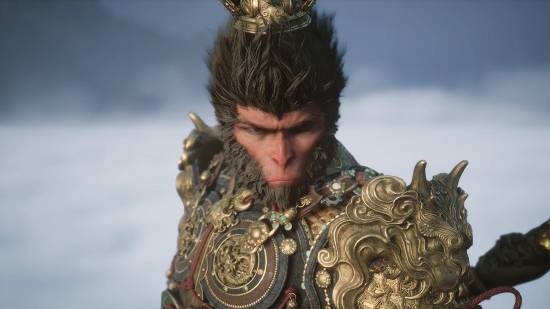
It is worth noting that on July 28th, “Black Myth: Wukong” also appeared in CCTV’s “Xinwen Lianbo.” The state broadcaster highlighted: “Today in Zhejiang, companies like DeepSeek, Game Science, and Unitree Robotics are injecting powerful momentum into the integration of culture and technology.”
The repeated mentions of “Black Myth: Wukong” in “Xinwen Lianbo,” a highly authoritative and widely watched news program in China, underscore the game’s significant impact beyond its commercial success. This coverage signifies the government’s acknowledgment of the game’s role in promoting cultural soft power and contributing to the growth of China’s service export sector. The game’s ability to captivate international audiences while drawing inspiration from profound Chinese mythology positions it as a key player in China’s cultural export strategy, reinforcing the narrative of China’s advancing global influence through culture and technology.
