
Initially, I didn’t pay much attention.
But as I watched, I felt like this GIF was on an endless loop, never reaching its end.
It wasn’t until a colleague casually asked, “Could this actually show the whole movie?” that I realized the gravity of the situation—
It turned out the GIF contained the entirety of “Ne Zha 2.”

However, the truth was far more complex. After some searching, I discovered:
Behind the appearance of this GIF in WeChat groups was a self-initiated competition among netizens to achieve the extreme compression of “Ne Zha 2.”
This event became known as the “File Compression War.”
The saga reportedly began with a talented individual who managed to compress the original two-hour “Ne Zha 2” into a mere 50 MB, which was then shared in a QQ group.

Upon verification, the file was indeed only 50 MB, with a resolution of 176×74, a frame rate of 15, and the full runtime intact.

While the image quality was akin to an ultrasound, anyone who had seen the movie could immediately recognize it as the genuine “Ne Zha.”
A quick screenshot from the article should suffice to confirm the film’s identity.

This file was then rapidly shared across various chat groups. Little did anyone expect, the compression competition had officially begun.
Soon after, another talented netizen emerged in the QQ groups, this time reducing “Ne Zha 2” to an astonishing 30 MB.
Predictably, the image quality deteriorated further, with the “barrier beast” transforming from two distinct blurry figures into a single amorphous blob.

With this new challenger, the “war” truly ignited, drawing in an increasing number of participants.
Versions of 20 MB, 15 MB, and even as low as 2.2 MB began to surface relentlessly.

As screenshots of these conversations went viral, the battleground expanded from QQ groups to platforms like Bilibili and Douyin.
A multitude of tech enthusiasts joined the fray, not for any practical purpose, but driven by the challenge of pushing the limits and seeing who could compress the movie to the smallest possible size.
Some managed to shrink “Ne Zha 2” down to 577kb, while others reached an astonishing 4.46kb, declaring it the theoretical minimum and effectively ending the competition.

Did you think that was the end?
Surprisingly, a 7kb version then emerged, effectively “killing the king” of the competition.
Frankly, the few characters I just typed are already larger than 7kb.

Some readers might wonder if the video is still watchable at such minuscule sizes.
In reality, from the 15 MB mark onwards, the video had largely lost its watchable qualities. By the time it reached hundreds of kilobytes, the experience was reduced to a chaotic collision of color blocks.

After all, in this competition where smaller is better, the nature of the game had shifted entirely. The goal was no longer to create a watchable video, but simply to achieve the smallest possible file size.
Consequently, as the visuals degraded to a point where watching for just two minutes could strain one’s eyes, the competition gained a more poignant nickname: “The File Compression War: Eye Strain Edition.”
You might be curious how individuals managed to compress a multi-gigabyte movie file down to the kilobyte range.
The process itself is not overly complicated.
Traditional video compression involves a delicate balancing act: reducing file size without compromising visual quality. Higher bitrates lead to larger files, while lower bitrates can result in blocky artifacts during fast-paced scenes.

However, for this competition, the guiding principle was singular: “delete.”
First, **resolution was drastically reduced**. This is arguably the most straightforward and impactful method. The original 4K or 1080p image was downscaled to a resolution so low, it resembled a heavily artifacted image from the early days of digital media, like 144×72. Fewer pixels naturally translate to a smaller file size.
Next, **frame rate was significantly decreased**. If a video with 24 frames per second is standard, then a video with 5 frames, or even just 1 frame per second, could still technically be considered a video, right? By discarding excessive frames and retaining only the key motion, the file size could be further reduced dramatically.
4K 60 FPS = Large file size, 60 frames per minute

**Finally, bitrate and color depth were lowered.** The bitrate determines how much data is included per second of video, and color depth dictates the range of colors displayed. By reducing the bitrate to its absolute minimum and cutting down the millions of available colors to a mere 256, the video would inevitably become abstract, but its file size would shrink considerably.

Similarly, **audio could be ruthlessly manipulated**. By continuously lowering the sampling rate and bit rate, high-quality audio could be reduced to the level of an old-fashioned telephone. This explains why many compressed versions of “Ne Zha 2” featured distorted sound, as if emanating from underwater, or why some versions completely omitted audio altogether.
Of course, talking is cheap; let’s see it in action.
To test the limits of video compression, the author enlisted the help of a video post-production expert. They prepared a file of “Initial D,” a movie lasting 1 hour and 49 minutes, with an initial size of 1.19 GB.
This file was then processed through three software applications: Premiere Pro, Format Factory, and Permute, with all parameters aggressively set to their lowest values.


The final results were 17 MB for Premiere Pro, 17 MB for Format Factory, and 61 MB for Permute.
Although Premiere Pro and Format Factory both yielded 17 MB files, the actual quality difference was significant.
The Premiere Pro output resulted in a visually fragmented video with only clear audio.

The Format Factory output, while maintaining clearer visuals, suffered from a very low frame rate, and the iconic voice of Jay Chou was distorted into a robotic monotone.

Subsequently, the file exported from Premiere Pro was further compressed, resulting in a final size of 10 MB.
This was achieved using the default settings of the software. As mentioned earlier, further reductions could be made by manually lowering the frame rate, such as to 1 frame per second.
These extensive tests were not performed for the sake of this article’s detail.

Finally, converting the video to GIF format led to another significant reduction in file size.
The high-definition version below is approximately 5 MB.


There were also versions reaching an extreme of 66kb, where the visuals were reduced to mere flickering pixels.
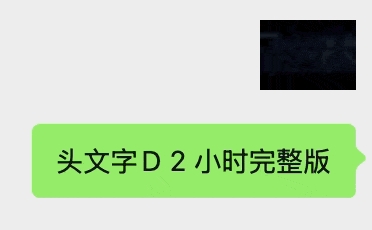
However, due to frame rate limitations within the WeChat official account backend, sharing these extreme examples was not possible.

It’s worth noting that similar compression challenges have been documented before, such as the 13kb game development contests and the 4kb demo scene competitions.
In those events, developers skillfully created complex and innovative games within a strict 13kb limit.
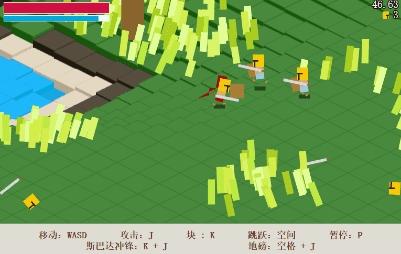
Similarly, artists produced visually stunning demo videos lasting several minutes, all constrained to a mere 4kb.
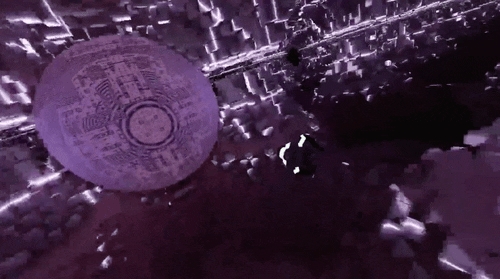
However, the “File Compression War” for “Ne Zha 2” differs significantly from these previous geek competitions.
Its core focus was not on “what can I create with this limited space,” but rather on “look how small I can make this file.” The watchability of the content after compression was of secondary importance, if not entirely irrelevant.
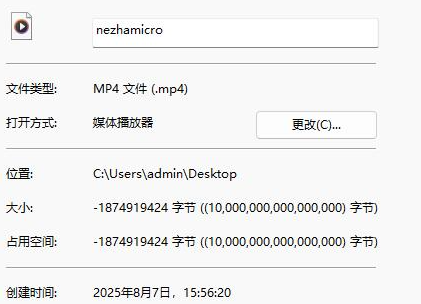
One participant even claimed to have achieved a negative file size, implying a bizarre scenario where watching an episode somehow resulted in a gain of 50 GB of data.
This competitive compression drive by netizens, almost an act of performance art, has evolved into something abstract.
The actual size of the movie is no longer the pivotal factor.
What matters is that participants, through a somewhat absurd endeavor, engaged in a collective digital carnival.
The essence of this “File Compression War” is essentially an inside joke, understood only by those within the community. Through repeated sharing and escalation—
It transformed into a peculiar online spectacle.
