
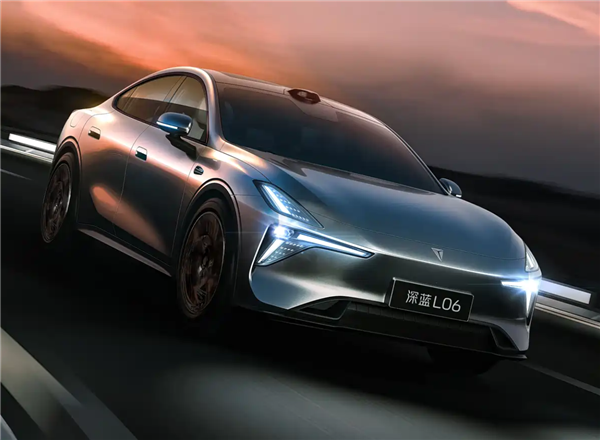
September 25, China – Deepal Motors has officially announced that the Deepal L06 will feature “magnetorheological fluid,” marking a significant first for Chinese automobiles to adopt this advanced technology.
Magnetorheological fluid, previously confined to high-precision engineering fields like military and aerospace, was first introduced to the automotive sector in 2002, finding its way into supercars from brands such as Ferrari and Lamborghini.
Deepal began its research into magnetorheology in 2020. To accommodate this innovative fluid, the company also implemented Tesla-class integrated die-casting technology, with the Deepal L06 leveraging this same advanced manufacturing process for its magnetorheological suspension system.

Magnetorheological fluid is an intelligent material composed of micron-sized iron particles. Its defining characteristic is its ability to instantaneously alter its viscosity under the influence of a magnetic field.
When an electric current passes through the electromagnetic coil within the shock absorber, the generated magnetic field causes the iron particles to align into chains. This transforms the fluid from a freely flowing liquid state to a semi-solid state, thereby increasing damping force. Upon power disconnection, the particles revert to a random distribution, and the fluid’s viscosity decreases.
This system offers active damping adjustments at a rate of 1,000 times per second, with response times in the millisecond range. By dynamically adjusting suspension stiffness based on real-time data from sensors—monitoring vehicle speed, steering angle, and road surface conditions—it precisely matches the optimal damping for various driving scenarios. This level of intelligent control signifies a leap forward in automotive suspension technology.
Compared to traditional Continuously Variable Damping (CDC) electromagnetic suspensions, which rely on mechanical adjustments of hydraulic oil flow via electromagnics valves, magnetorheological suspensions eliminate the need for complex valve bodies. They offer a wider adjustment range (damping force can vary from near zero to extremely high), produce less noise, and boast higher reliability. Their superior performance is particularly noticeable when navigating continuously damaged road surfaces or during high-speed cornering.
Notably, the Deepal L06 not only incorporates the magnetorheological suspension system, similar to that found in Ferrari supercars, but also debuts the world’s first and only automotive-grade 3nm cockpit chip. Additionally, it features a dual-core high-computing-power chip for one-stage, end-to-end intelligent assisted driving. The integration of these cutting-edge technologies in a Chinese new energy vehicle positioned around the 150,000 RMB price point truly embodies the concept of “technology democratization.”


