
As the National Day holiday approaches, many are already planning their getaways. It’s a common sentiment that work takes a backseat during this time. While the excitement of holiday travel is palpable, it often comes with its own set of challenges, essentially a rigorous “training session” of recurring inconveniences. One of these is the pervasive travel anxiety that kicks in after booking transportation.
For many, including myself, the period between securing a train ticket and actually boarding can involve obsessively checking the booking app countless times. Questions like, “Did I book for Hongqiao station?” “What time is the departure again?” and “Which carriage is mine?” become a constant refrain. Even when a stranger sits near my designated seat, I find myself double-checking my carriage and seat number, fearing the ultimate holiday mishap of boarding the wrong train, effectively ending the vacation before it even begins.

This, however, is just the beginning. Upon arriving in a new city, the real trials commence. Catching a taxi at a high-speed rail station or airport during holidays is an experience that can only be described as “exhilaratingly frustrating.” The queues can snake around the entire venue. You can’t easily hail a cab without walking to a designated pick-up point, yet you’re hesitant to call one in advance for fear of the driver canceling the order due to waiting time. Opting for the subway involves deciphering complex route transfers and station exits, a task that can consume a significant amount of time.
The most irksome aspect, however, is often the payment for public transportation. As is well-known, each city operates its own transit system. To use the subway or buses, you might need to obtain a local transit card, or go through a cumbersome verification process to activate a local QR code on platforms like Alipay or WeChat. Alternatively, you might have to download a city-specific official app, possibly one designed for temporary holiday use.
While obtaining a physical card might seem like the most straightforward option for many, it presents its own set of dilemmas. Insufficient stored value coupled with the inconvenience of card refunds can be a recurring headache. The digital QR code solutions, while convenient, are susceptible to poor signal reception or a drained phone battery, leaving travelers stranded at the ticket gates. Being stuck is one thing; being stuck with an impatient queue behind you, complete with judgmental glares, amplifies the discomfort significantly.

Individually, these issues might seem minor. However, when they all converge and confront you simultaneously, they can easily sour the joyous mood of a holiday trip. Fortunately, there appears to be a consolidated solution emerging for these travel-related annoyances, and it’s surprisingly straightforward: leveraging the capabilities of your HarmonyOS 5 phone.
HarmonyOS 5 integrates fundamental features that can effectively address many of the aforementioned travel challenges. For those who repeatedly check their journey details before boarding a train or plane, HarmonyOS 5 introduces a “Service Status” feature directly on the leftmost screen. By linking your accounts with relevant travel apps like 12306 or flight tracking services, your train and flight information is automatically aggregated into a convenient card. For an upcoming high-speed train journey scheduled for the 17th, this card displays the departure station, time, boarding gate, and seat number, all accessible with a simple swipe from the home screen.
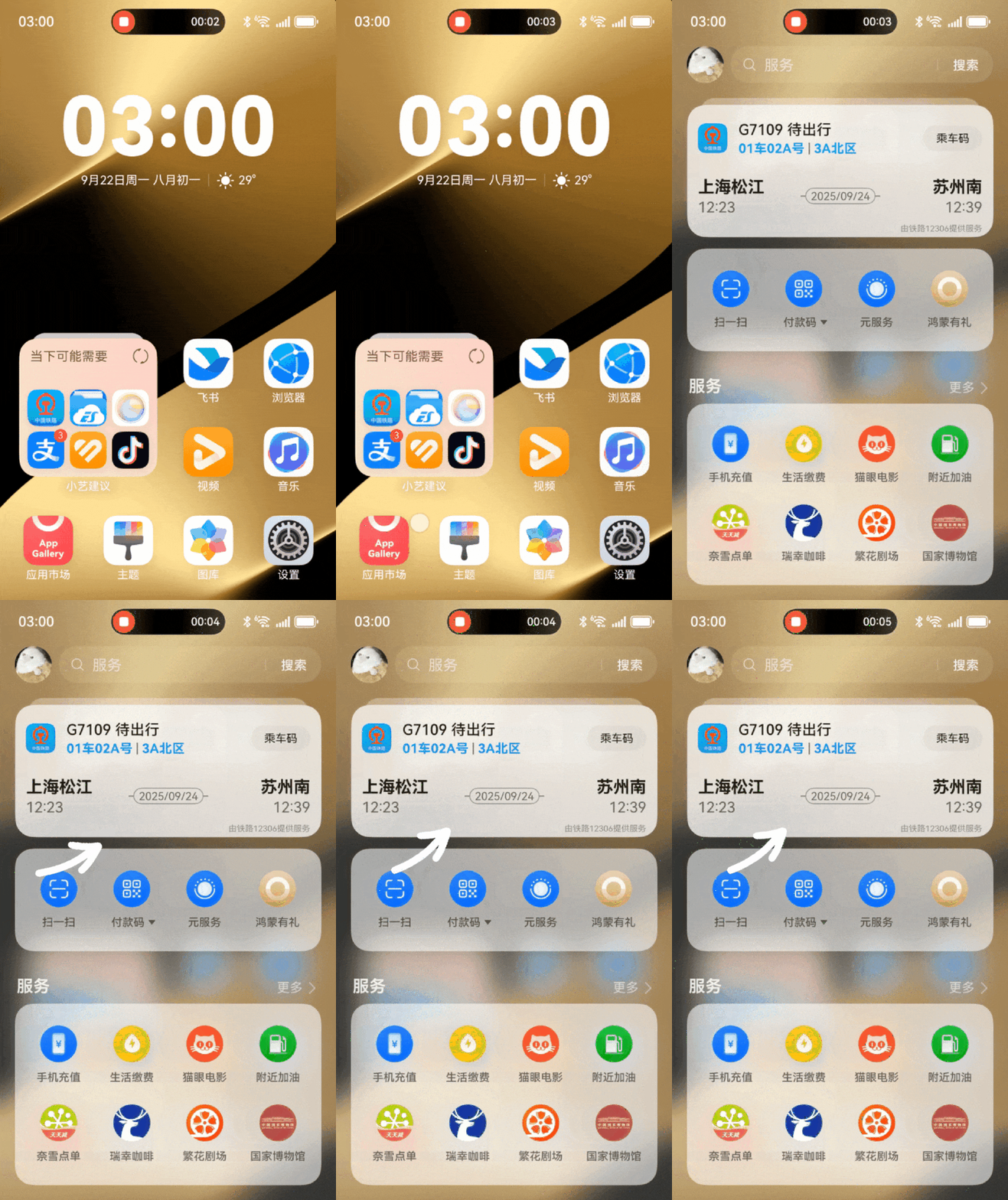

Crucially, this card is dynamic; its status updates in real-time, showing “Departure Reminder” or “Scheduled Arrival” as the journey progresses. The service buttons on the right also adapt to the current status. Before boarding, it might display a “Boarding Pass” function. Once on board, it could offer “In-flight Dining.” Upon arrival, it may transform into a “Ride Hailing” option. This integration provides both essential information and seamless convenience, eliminating the need to constantly open and navigate through multiple apps.

Having arrived at your destination thanks to these integrated features, the next question is how to navigate locally. The options typically include: A) Taking a taxi, which can be costly and involve long waits. B) Using public transportation, which requires downloading apps or managing transit cards. C) Following this suggestion.
For those who choose option C, a practical recommendation is to explore the “Wallet” feature within HarmonyOS 5 and activate the “Seamless Travel Card” (‘畅行无忧卡’). This card’s primary advantage is its sheer convenience. It’s compatible with metro and bus systems in over 330 cities across China. Whether traveling to major metropolises like Beijing or Shanghai, or to charming smaller cities, as long as the transit gates display the “UnionPay” or “Transportation Union” logo, you can use this card. This effectively eliminates the need to frequently download apps or switch between QR codes and physical cards.

Furthermore, the card offers a “pay-as-you-go” model with no upfront activation fees. Upon activation, it comes with a 20 yuan travel credit, which is pre-funded by the system and subsequently deducted from your linked bank account. This eliminates the common dilemma of how much to pre-load onto a transit card, ensuring you never over- or under-charge. Most importantly, even if your phone has no network connection or is out of battery, the card remains functional. Huawei Wallet utilizes NFC technology, allowing you to pass through ticket gates with a simple tap, even when the device is powered off.

Beyond public transportation, many opt for road trips or choose to simply relax at home during the holidays. HarmonyOS 5 also addresses these scenarios with a wealth of convenient features integrated into its leftmost screen, specifically through “Elemental Services” (元服务). These are lightweight applications that can be used instantly without the need for downloads.

For those embarking on road trips, the leftmost screen provides direct access to “Nearby Gas Stations.” You can instantly see fuel prices and distances. Similarly, for those staying home, you can access quick services like short video streaming, movie watching, or ordering beverages by simply tapping on the corresponding Elemental Service cards for popular brands or content platforms. This approach negates the necessity of downloading numerous individual apps.


Further enhancing the user experience, HarmonyOS 5 also provides access to various promotional offers and discounts. The “Daily Rewards” section within “Harmony Gifts” (鸿蒙有礼) on the leftmost screen is a valuable resource for finding discounts on everyday necessities such as train tickets, short videos, beverages, and fuel. Huawei Pay also offers attractive incentives, with new users receiving discounts of up to 6 yuan on purchases within Huawei Video and Themes. Observation of user feedback, such as a screenshot from Xiaohongshu showing consistent daily check-ins for 25 days in the “Harmony Gifts” section, suggests a pattern of accumulating benefits.


In summary, whether you plan to explore the outdoors or relax at home this National Day, HarmonyOS 5 proactively addresses common travel and daily life inconveniences. The “Seamless Travel Card” simplifies transit across more than 330 cities nationwide, eliminating the hassle of managing transit cards. Huawei Pay’s various discounts offer cost savings and convenience, while the leftmost screen’s Elemental Services provide instant access to entertainment and daily needs without app downloads.
HarmonyOS 5 focuses on practical functionalities that genuinely resolve specific issues encountered during travel or at home. This is perhaps what truly defines a good system service: it operates subtly in the background, yet provides timely and effective solutions when needed. By minimizing the friction of everyday tasks, it allows users to dedicate their valuable energy to simply enjoying the holiday itself.
