
<p>Many of the traditional festivals we celebrate today have roots stretching back through considerable history. For instance, the Spring Festival (the first day of the lunar year) originated in ancient times. The Winter Solstice and the Duanwu Festival (the fifth day of the fifth lunar month) have been celebrated since the Han Dynasty. New Year's Eve and Qixi Festival emerged in the Jin Dynasty. The Chongyang Festival gradually took shape between the Han, Wei, and Southern and Northern Dynasties. While the Qingming Festival and Laba Festival appeared a bit later, their primary ancestral rituals, the Shangsi Festival and the Zha sacrificial ceremony, can be fully traced back to the pre-Qin and Han dynasties.</p>In contrast, the festivals of the “Yuan Ye/Yuan Xiao” on the fifteenth day of the first lunar month and the “Mid-Autumn Festival” on the fifteenth day of the eighth lunar month, which appeared during the Tang and Song dynasties, seem particularly “young” and their origins are more enigmatic.
Where did the Mid-Autumn Festival come from? Many theories abound, feel free to speculate!
Regarding the origin of the Mid-Autumn Festival, there are numerous theories within academic circles. Here are a few examples.
1. The “Sunset Moon” Theory
Ancient emperors would conduct sacrifices to the sun and moon on the days of the vernal equinox and autumnal equinox, respectively, referred to as “Chao Ri” (morning sun worship) and “Xi Yue” (sunset moon worship).
These “Chao Ri” and “Xi Yue” ceremonies, continuing from ancient times until the Qing Dynasty, were very significant imperial rituals.
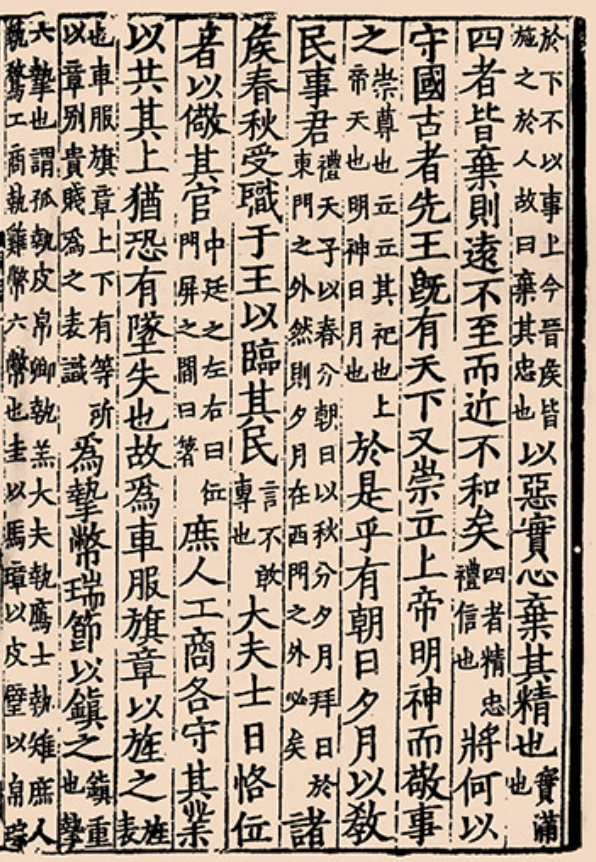

Image shows a facsimile of the Song Dynasty engraved and revised edition of “Guoyu” from the “Zhonghua Zaizao Shanben” collection.
Traditionally, one of the main activities of the Mid-Autumn Festival is “Bai Yue” (worshipping the moon). Furthermore, the “Autumnal Equinox” and “Mid-Autumn” can be considered midpoints of autumn in different senses. Therefore, many scholars wonder if the Mid-Autumn Festival might have been inspired by and imitated from the “Xi Yue” ceremonies by the common people.
However, direct evidence establishing a connection between the two has not been found in ancient texts.
Moreover, logically speaking, “Xi Yue” has always been explicitly designated as an imperial exclusive sacrifice. Which commoner would dare to “imitate” it, fearing the extermination of their entire clan?
Throughout history, there have been numerous tyrannical rulers and countless absurd, unfounded decrees. Why have we never heard of an emperor issuing an order like, “The Mid-Autumn Festival is too similar to Xi Yue, how dare you! Ban it!”?
This suggests that in the eyes of ancient people, “Xi Yue” and “Mid-Autumn” might not have had much in common.
2. The “Autumn She” Theory
Ancient China was an agricultural society. In spring and autumn, there were joyous and lively agricultural festivals derived from sacrificial activities, known as “She Ri” (She days).
Among these, “Qiu She” (also called “Qiu Bao,” meaning autumn reward, with its timing uncertain, often set after the harvest of the most important local staple crop, such as the fifth *wu* day after the beginning of autumn) sometimes coincided with the Mid-Autumn Festival, and both shared a pronounced celebratory attribute.
Thus, some scholars hypothesize that the Mid-Autumn Festival may have evolved from “Qiu She.”
The issue is that “Qiu She” was quite prosperous from the pre-Qin era to modern times, and even in some rural areas today, it is still celebrated. This festival has coexisted with the Mid-Autumn Festival for a millennium, and they are clearly distinct.
Furthermore, “She Ri” is a typical agricultural festival, primarily worshipping the Earth God (as indicated by the “earth” radical in the character ‘she’). In some regions, people might have also offered sacrifices to water gods, cloud gods, and so on. However, the moon deity worshipped during the Mid-Autumn Festival seems to have no direct connection to agricultural production.
3. The Emperor Xuanzong of Tang Theory
Emperor Xuanzong of Tang, who presided over the prosperous Kaiyuan era and later instigated the An Lushan Rebellion, made many far-reaching innovations.
One such innovation was establishing his birthday as a specific festival. His birthday fell on the fifth day of the eighth lunar month, initially called “Qianqiu Festival” and later renamed “Tianchang Festival.”
After him, most monarchs declared their birthdays as national festivals, for instance, during the Ming and Qing dynasties, they were known as “Wanshou Festival” (Festival of Ten Thousand Longevities).
The Qianqiu Festival during Emperor Xuanzong’s reign was extremely lively. Not only was there a three-day national holiday, but grand acrobatic performances were also held in front of the renowned Hua’e Xianghui Tower. These performances included popular acts of the time such as “Wu Ma” (dancing horses), “Sheng Ji” (tightrope walkers, where ‘ji’ refers to female performers), and “Xian Gan” (a general term for acrobatics using long poles, including activities like cart poles, climbing poles, juggling poles, and balancing poles, e.g., balancing a long pole on one’s head while several people somersaulted and sang on top of it).
During that period, the number of commoners flocking to Hua’e Xianghui Tower to celebrate the emperor’s birthday (and “incidentally” enjoy the free acrobatics) was immense. By the twenty-fourth year of the Kaiyuan era, the court even had to dismantle two large blocks of houses to expand the plaza in front of the tower. This festival was, indeed, as lively as the later Mid-Autumn Festival.
So, how did the “Qianqiu Festival” on the fifth day of the eighth lunar month transform into the “Mid-Autumn Festival” on the fifteenth day of the eighth lunar month? Scholars have also cited the legend of “Xuanzong’s Journey to the Moon Palace.”
This story has many versions.
For example, the Dunhuang Bianwen (a popular narrative and singing literary form during the Tang and Five Dynasties period) “Ye Jingneng Shi” records that on the night of the fifteenth day of the eighth lunar month in the fourteenth year of the Kaiyuan era, Emperor Xuanzong, while admiring the moon with his ministers, suddenly became curious and asked the sorcerer Ye Jingneng by his side: “What is it like on the moon?”
Ye Jingneng replied, “This question is too complex to explain clearly. How about I take the emperor up to see?” Emperor Xuanzong, filled with excitement, donned a simple white cotton robe and followed the sorcerer to the sky.
In the Moon Palace, he witnessed pavilions and towers made of crystal, colored glaze, and agate, a giant, swaying tree with leaves like silver and flowers like clouds, and several celestial maidens adorned in jeweled robes.
Faced with this fantastical world, Emperor Xuanzong exclaimed with genuine feeling: “It’s… so cold! Quickly… let’s go back… go back quickly!”
Hearing this, Ye Jingneng had no choice but to swiftly escort him back to Earth.
Of course, this story is purely the product of ancient imagination. The moon lacks an atmosphere, and the temperature difference between day and night is extreme. The illuminated side of the moon (daytime) typically reaches over 100 degrees Celsius, far from the “icy cold” it appears to be.
However, the ancients found it incredibly romantic and spoke of it with great relish, passing the story down through generations.

In most extant literary records that mention this event, the sorcerer’s name is changed to Luo Gongyuan.
For instance, the version in “Taiping Guangji” states that Emperor Xuanzong first heard the melody “Song of Rainbow Skirts and Feathered Clothes” in the Moon Palace. Of course, playing music in a vacuum would render it inaudible, no matter how beautiful.
This legend was extremely popular in ancient times and seems to have indeed heightened people’s attention to the moon on the fifteenth day of the eighth lunar month.
From the era of Emperor Xuanzong of Tang onward, poems specifically celebrating the moon on the fifteenth day of the eighth lunar month saw a significant surge.
For example, the mid-Tang poet Wang Jian’s poem “Looking at the Moon on the Fifteenth Night, Sent to Vice-Director Du” reads: “The courtyard is white, and crows nest in the trees; cold dew silently wets the osmanthus flowers. The moon is bright tonight, and everyone looks up; who knows whose autumn thoughts are wandering?”
Given the “cold dew” and “osmanthus flowers” in season, it likely refers to the eighth lunar month; the moon being “everyone looks up” indicates that moon-gazing had become a widespread custom.
His other poem, “Responding to Vice-Director Yuan, Playing with the Moon from the Twelfth to the Fifteenth Night of the Eighth Month (Part 5),” states: “Looking up, standing in the wind for five nights, from never being full until it was full.”
Watching the moon every night for five consecutive nights, gradually seeing it become full, demonstrates the strong ritualistic sense of moon-gazing on the fifteenth day of the eighth lunar month.
However, the earliest existing historical records about the Mid-Autumn Festival do not emphasize the story of Emperor Xuanzong’s journey to the Moon Palace. Therefore, many believe that this festival is unlikely to have been birthed from a legendary tale.
4. The “Zhongqiu Nuo” Theory
Recently, some scholars have proposed that the Mid-Autumn Festival may have evolved from the Zhongqiu Nuo (mid-autumn Nuo).
In ancient times, there were three major Nuo ceremonies (dance rituals to welcome spirits and ward off ghosts, with the New Year’s Eve traditions originating from the winter Nuo): late spring Nuo, mid-autumn Nuo, and late winter Nuo. The mid-autumn Nuo was fixed on the day before the autumnal equinox during the Sui Dynasty.
The deities welcomed in Tang Dynasty Nuo plays were primarily the “Taiyin God.” It is said that the bright moon possessed the power to purify evil spirits. A late Tang poem by Sun Wei, “Thinking of Zheng Yanmei on the Mid-Autumn Night, Composed on a Sudden Impulse,” reads: “Mid-Autumn, midnight moon; the world says it banishes evil spirits.” To use the moon’s power to “disinfect” the world, it would be best to choose a night with a full moon.
Therefore, it is believed that the Tang people may have shifted the mid-autumn Nuo to the fifteenth day of the eighth lunar month.
Historical records indicate that the spring and mid-autumn Nuo ceremonies in the Tang Dynasty exhibited strong secularization tendencies, leading them to be completely removed from official sacrificial rites and become lively folk activities.
Later, Buddhist clergy organized grand vegetarian feasts during the mid-autumn Nuo period, making the Nuo plays even more vibrant. This may be the origin of the Mid-Autumn Festival.[1]
Myriad people gather all night to celebrate, lighting lanterns and eating cakes for reunion.
If we exclude the “Zhongqiu Nuo,” the extant historical records of Tang Dynasty customs for celebrating the fifteenth day of the eighth lunar month are primarily limited to moon-gazing. By the Song Dynasty, the Mid-Autumn Festival had officially separated from Nuo plays (if it indeed originated from Zhongqiu Nuo), becoming a distinct festival, and the name “Mid-Autumn Festival” was established.
The Song Dynasty’s “Tokyo Meng Hua Lu” records: “On the Mid-Autumn night, noble families decorated their pavilions, and commoners vied to occupy taverns to admire the moon. Music filled the air. Residents near the inner court could faintly hear the sounds of zithers and flutes from afar at deep night, as if from beyond the clouds. Children in the villages played throughout the night. The night markets were bustling until dawn.”


Image shows a copy of “Mengliang Lu” from the “Zhi Buzhai Congshu” collection.
Another Song Dynasty ancient text, “Meng Liang Lu,” records: Even the poorest people on this day would pawn their clothes to buy wine for celebration. In this description, the importance of the Mid-Autumn Festival is comparable to New Year’s Day.
Customs of the Mid-Autumn Festival also include worshipping the moon, lighting lanterns, and family reunions. The custom of lighting lanterns during the Mid-Autumn Festival differs from the Lantern Festival; lanterns during Yuan Xiao are placed on the ground, while Mid-Autumn lanterns are often floated on water.
Zhou Mi’s “Wulin Jiushi” (where “Wulin” is an alias for Hangzhou, not related to martial arts circles) records: “On this evening, Zhejiang releases tens of thousands of small sheepskin water lanterns called ‘Yi Dian Hong’ (a single red dot), filling the water surface, as brilliant as a starry sky.” The river lanterns resemble stars, perfectly matching the bright moon in the heavens. The fullness of the moon reminds people of reunion among loved ones. It is this sentiment that led Su Shi, while “drinking happily until dawn” on the “Mid-Autumn Festival of Bingchen,” to suddenly think of his distant brother Su Zhe and write the famous lines: “When will the bright moon appear? I raise my wine and ask the azure sky.”
Another great lyricist, Lü Benzhong, also has a classic poem, “Cai Sang Zi.” “I resent that you are not like the moon over the river, north and south, east and west. North and south, east and west, only to accompany each other without separation. I resent that you are like the moon over the river, sometimes full, then waning. Sometimes full, then waning, when will it be full again?”
According to Song Dynasty records, people near Bianjing (Kaifeng) would eat a dish called “Wanyue Geng” (moon-viewing soup) during the Mid-Autumn Festival, although the exact preparation of this soup remains unknown.
At that time, there was also a round cake called “Yuebing” (moon cake), but it was not yet a seasonal food for the Mid-Autumn Festival. Some argue that Su Shi’s poem “Farewell to Governor Lian,” which mentions “small cakes like a chewed moon, with su and yi inside,” refers to today’s mooncakes. However, this poem has nothing to do with the Mid-Autumn Festival from beginning to end, and the phrase “chewed moon” suggests the “small cakes” in the poem were not round, contradicting the Mid-Autumn Festival’s theme of reunion, making it unlikely to have become a seasonal food for the festival.
The mooncakes we eat today likely emerged during the Ming Dynasty.[2] Shen Bang’s “Wanshu Zaji” from the Ming Dynasty states: “Households, both commoners and officials, all make flour cakes in this month to exchange with each other, of various sizes, called ‘moon cakes.’ Market stalls even offer cakes with fruit fillings, ingeniously named and distinctively shaped, with some cakes costing several hundred *wen*.”
Although the origin of the Mid-Autumn Festival remains a subject of much debate, this has not hindered its status as one of China’s most important traditional festivals.
The full moon hanging high in the sky embodies reunion and longing, and it carries the warmth and poetic sentiment of millennia of culture.
On this joyous occasion, we extend our sincerest blessings to our readers: Happy Mid-Autumn Festival, and may your reunion be blessed with the moon and loved ones.
References
[1] Zhao Yuping. A New Theory on the Origin of the Mid-Autumn Festival—A Discussion on the Role of Tang Dynasty Buddhist Vegetarian Feasts in its Evolution [J]. Journal of Festivals Research, 2025, (01): 22-32.
[2] Yang Lin. Chinese Traditional Festival Culture [M]. Beijing: China Religious Culture Press, 2000.
关于作者
