
Recently, a photographer captured a rare scene: a honey badger, known affectionately as the “Honey Badger Don’t Care,” single-handedly confronting two tigers. Although the badger was clearly at a disadvantage and endured a significant struggle, viewers were nonetheless impressed by its sheer courage and lauded its bravery.

The honey badger, widely recognized online as the “boss of the wild” or “Honey Badger Don’t Care,” has earned a formidable reputation for its fearlessness and its tendency to challenge much larger predators such as lions, tigers, and hyenas. Even large herbivores are not exempt from being driven away by the badger’s tenacity. This unwavering boldness has cemented its image as an animal that simply does not back down.
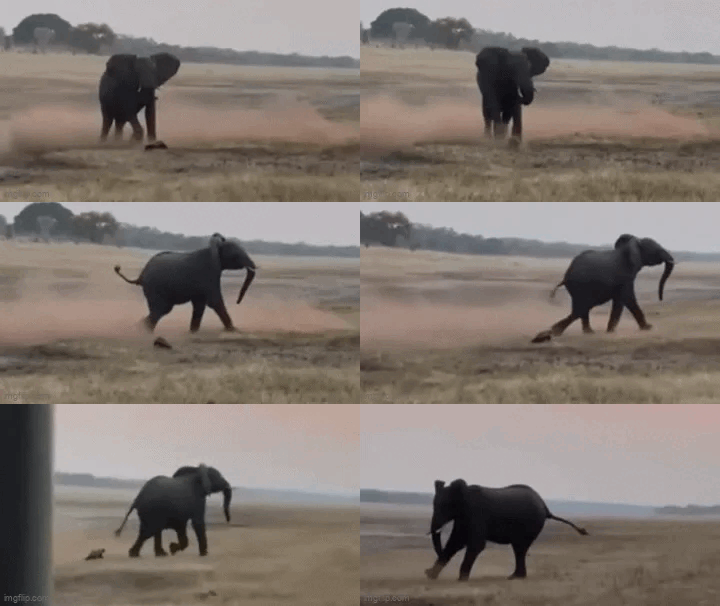
△ An unimpressed elephant and a tireless honey badger!

△ The honey badger shows no fear, even in the presence of a lion!
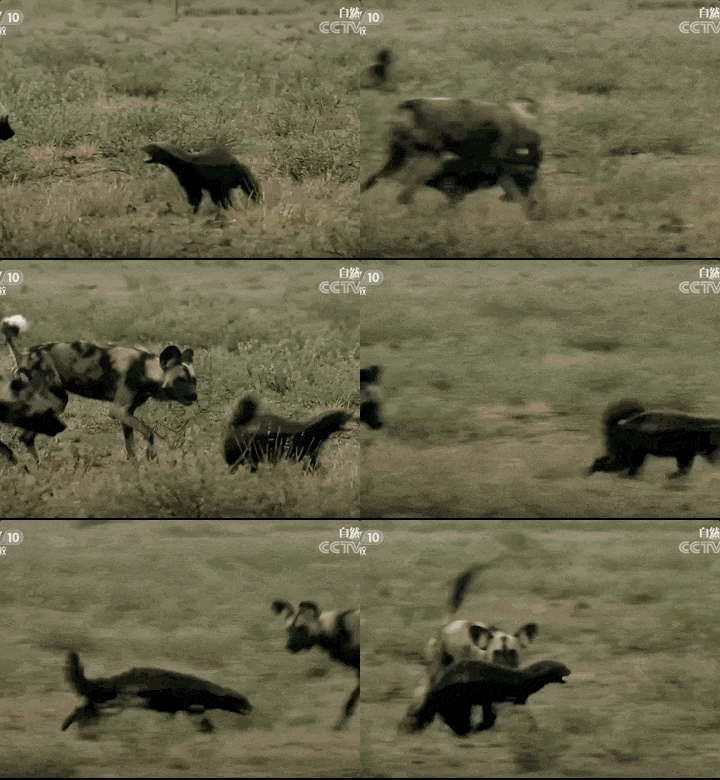
△ A single honey badger confronts a pack of African wild dogs!
Many people often wonder about the basis of the honey badger’s audacious behavior and its actual combat capabilities. Why does it dare to challenge such formidable adversaries?
Have you ever noticed the peculiar coloration of the honey badger?

It is a well-established principle in nature that vibrant colors such as red, yellow, and blue often serve as warning signals, indicating danger to potential predators. The poison dart frog, for instance, effectively utilizes these bright aposematic colors to deter predators. However, it is less commonly known that the honey badger’s stark black and white pattern also functions as a form of aposematism. This distinctive coloration serves as a “danger signal” or “status signal” to the wider animal kingdom, effectively communicating that it is not to be trifled with.
Interestingly, this black and white warning coloration in honey badgers is arguably more intimidating to natural predators than the vibrant hues of other venomous creatures. The venomous snakes belonging to the Elapidae family, for example, share a similar aposematic color scheme with the honey badger.
Furthermore, there is a fascinating phenomenon in the natural world where certain animals evolve to mimic the appearance of the honey badger to enhance their own survival. This mimicry, known as Batesian mimicry, is similar to how harmless snakes imitate the appearance of venomous ones.
This mimicry is particularly evident in young cheetahs. The white markings on their backs are believed to be an adaptation for mimicry, potentially impersonating the honey badger to deter predators. When you consider the resemblance, it becomes quite striking:

Aposematic coloration generally makes animals more conspicuous and thus more easily detected by predators. Consequently, this survival strategy is typically employed by animals possessing potent venom or other defenses that predators learn to avoid. The reasoning is that predators, through repeated negative experiences, learn to associate these conspicuous signals with unpleasant or dangerous encounters.
Given this, it’s a curious paradox that the honey badger, which does not possess potent venom like many other aposematic species, also adopts this strategy. How does it compel predators to recognize it as a creature to be avoided?
The honey badger’s primary method of deterring predators is through its unwavering and aggressive defense. It relies on its willingness to fight back ferociously, irrespective of the size or power of its adversary.

An animal’s combat effectiveness is often correlated with its physical attributes, particularly its size. Honey badgers typically weigh between 9 and 16 kilograms. While this makes them relatively large within the weasel family (Mustelidae), they are minuscule compared to predators like lions and tigers. In a direct confrontation, based purely on size, a honey badger stands no chance against such giants. It’s akin to a 50kg boxer facing an 80kg opponent; regardless of skill, the size disparity in the ring presents an insurmountable challenge.
While it’s undeniable that lions and tigers could easily overpower a honey badger, the critical factor is that the honey badger fights back with extreme ferocity. Lions and tigers, like all animals, are wary of injury, and a creature as small as a honey badger is simply not worth the risk of a potentially debilitating fight. Therefore, under normal circumstances, they tend to avoid engaging with honey badgers.

But what enables the honey badger to engage in such aggressive resistance?
This remarkable resilience stems from a combination of exceptional physical adaptations honed over generations of evolution.
Firstly, their neck skin is extraordinarily tough and loose.
The honey badger’s skin is generally thick and durable, providing protection against the stings of bees and the bites of venomous snakes. However, the skin around its neck is particularly noteworthy for its thickness, which can reach up to 6 millimeters, and its remarkable looseness. This combination makes it exceedingly difficult for predators to gain a secure grip and subdue their prey by targeting the neck, a common predatory tactic.

It is important to note that while this specialized neck skin offers a significant advantage in defense, it is believed by some researchers that this trait evolved primarily for conspecific combat rather than specifically for anti-predator defense [1]. Honey badgers are solitary animals, yet they engage in frequent and intense territorial disputes with one another. This tough, loose neck skin likely evolved to allow them to sustain bites and grips during these intra-specific conflicts without being incapacitated.
Secondly, as members of the weasel family, honey badgers exhibit remarkable agility and strength.
Weasels are renowned for their ability to hunt prey larger than themselves; for instance, stoats often prey on rabbits ten times their size. This predatory success is attributed to their powerful musculature and formidable bite force. The honey badger is no exception, possessing exceptional strength and a bite force considered to be among the strongest for its size within the Mustelidae family.

Moreover, weasels are known for their ability to kill venomous snakes, a feat made possible by their incredible agility, which allows them to skillfully evade snake strikes. Honey badgers, too, are adept hunters of venomous snakes, demonstrating their prowess in this dangerous arena.
Thirdly, the honey badger possesses a defense mechanism common to many weasel species: the release of a noxious gas.
Many are familiar with the behavior of weasels (such as the least weasel) that, when threatened or captured, emit a strong, offensive odor to disorient their attackers and facilitate escape. This defense is mediated by a specialized gland, known as the anal gland or perianal gland.
In fact, almost all members of the weasel family, with the exception of sea otters, possess these glands which secrete potent-smelling substances. These secretions serve multiple purposes, including communication, territorial marking, and, critically, as a means of defense.

Although the “stench” released by honey badgers may not be as persistent in the environment as that of skunks or some other mustelids, it is still sufficiently unpleasant to deter most predators. This combination of physical toughness, agility, and chemical defense allows the honey badger to effectively resist threats from a wide range of animals.
The cumulative effect of these advantages, and the successful encounters where they have been employed, has seemingly reinforced their naturally aggressive disposition, leading to a learned behavior of “fighting to win” and utilizing brute force whenever provoked. This constant reinforcement of successful, aggressive tactics likely contributes to their reputation as being exceptionally combative.
A final point to consider!
Scientific studies have confirmed that on the Serengeti plains, the honey badger population density is not significantly impacted by large predators such as lions. This suggests that lions, despite their size and power, generally choose to avoid conflict with honey badgers.
However, it is crucial to understand that honey badgers are not invincible. They do have natural predators, and at a lower trophic level, solitary leopards are known to prey on them.

For a leopard, a honey badger represents a suitable-sized prey item. Therefore, a leopard will hunt a honey badger regardless of its renowned fighting prowess or its capacity for aggressive resistance. In the face of a significant size and power disparity, such as that between a leopard and a honey badger, the latter’s formidable defensive tactics can ultimately prove insufficient.
