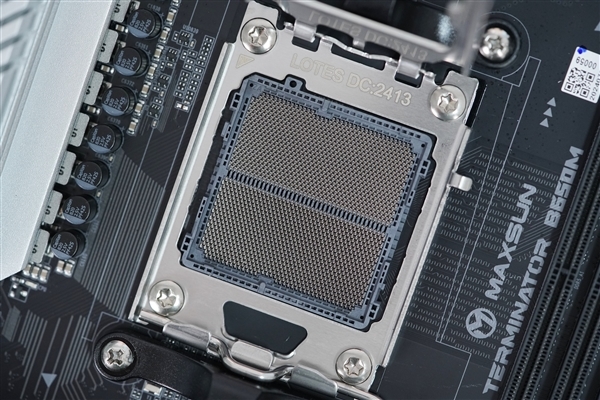
According to reports on August 15th, AMD’s upcoming Zen 7 processors are expected to be compatible with the current AM5 socket. This potential compatibility suggests that users who have invested in AM5 motherboards may be able to upgrade to future 32-core, 64-thread flagship CPUs based on the Zen 7 architecture.
A recent video by Moore’s Law is Dead highlighted that a leaker has reportedly encountered increasing information and documentation over the past few weeks pointing towards AMD’s intention to maintain AM5 socket support for its next-generation Zen 7 CPUs. This alleged shift in AMD’s strategy, described as a “recent decision,” is reportedly planned for implementation in the near future, extending the lifecycle of the AM5 platform beyond initial expectations.
AMD had previously committed in December 2023 that the AM5 socket would be supported through at least 2025 and beyond. So far, AMD’s launched Zen 4 and Zen 5 processors all utilize the AM5 socket. The next-generation Zen 6 processors are slated for release in 2026, also on the AM5 platform, and Zen 7 processors, anticipated around 2028, now appear likely to continue this trend.
If these leaks prove accurate, the AM5 socket could become one of the longest-supported CPU sockets in recent memory. This extended support would offer significant value to current users of Zen 4 processors, providing a clear upgrade path to Zen 5, Zen 6, and potentially even Zen 7 microarchitectures without requiring a motherboard replacement. Such a strategy would foster greater consumer loyalty and reduce the total cost of ownership for PC builders.
The Zen 7 processors are rumored to feature a design with 16 cores per chip, totaling 32 cores and 64 threads when combined. This would enable users to install significantly more powerful processors on their existing AM5 motherboards, maximizing the longevity of their hardware investments and providing a substantial performance boost over time.
It is important to note that these details are currently based on leaks and unconfirmed reports. Final product specifications and compatibility will ultimately be determined by AMD’s official announcements.