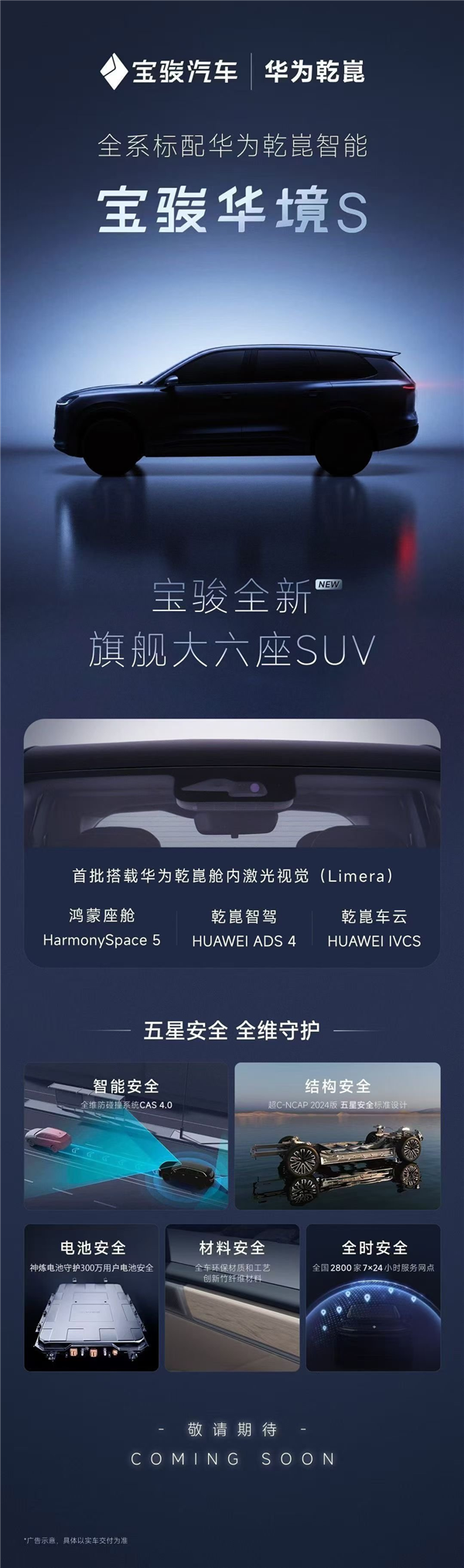
On September 11th, it was officially announced by SAIC-GM-Wuling Baojun that their first vehicle resulting from the collaboration with Huawei has emerged. According to the latest new vehicle declaration list from the Ministry of Industry and Information Technology, the Baojun Xiangjing S9 (which may also be referred to as Huajing S) has been revealed.
The new vehicle adopts a typical new energy vehicle design style, visually reminiscent of Li Auto’s L-series SUVs at first glance. It features a贯通式大灯 (through-type headlight) design but lacks split headlights. The retention of a large hexagonal grille contributes to a commanding presence.

The dimensions of the new vehicle are 5235mm in length, 1999mm in width, and 1800mm in height, with a wheelbase of 3105mm. These dimensions position it to compete with large SUVs like the Li Auto L9 and AITO Wenjie M9. The interior is configured with a six-seat layout.
The rear of the vehicle also sports a贯穿灯组 (through-type taillight) design, but the light sources within the housing feature a segmented, linear pattern that, when illuminated, creates a lightning-like effect, enhancing its distinctive identity.

In terms of powertrain, the vehicle is equipped with a plug-in hybrid system that includes a 1.5T engine (model LBT) manufactured by Liuzhou Saker Technology Development Co., Ltd., with a maximum engine power of 105 kW.


Particularly noteworthy is the announcement that this vehicle will come standard across all trims with Huawei’s Qiankun Smart Driving ADS 4.0, Hongmeng Cockpit HarmonyOS 4, and Qiankun Vehicle Cloud HUAWEI IVCS.
Furthermore, the vehicle utilizes Huawei’s Limera solution for cabin laser vision, the same system found in the new AITO Wenjie M7 Pro. This integration is expected to enable urban NCA (Navigation Cruise Assist) autonomous driving capabilities.
Considering the market positioning and brand identity of Wuling Baojun, the pricing for this full-size SUV is anticipated to be highly competitive, with a strong likelihood of breaking the 200,000 RMB mark, and potentially even reaching the 150,000 RMB segment. This could make it the sole large new energy SUV in its price bracket to feature both a Hongmeng cockpit and Qiankun intelligent driving system.