
Recently, our colleagues in the automotive department acquired a new gadget, claiming it would be quite an eye-opener for us.
However, after witnessing its capabilities, all Tesla owners in the company were left in stunned silence…
Let’s take a look at the GIF below first…
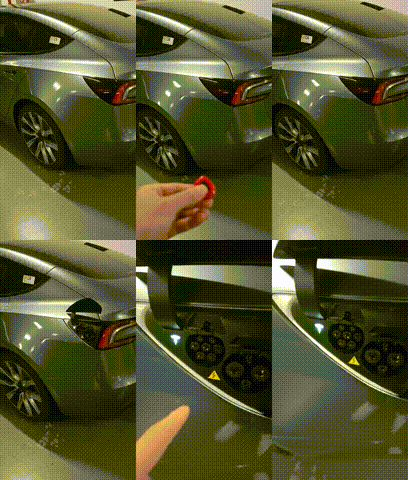

That’s right, this individual, with what looks like a toy, simply presses a button, and the Tesla’s charging port opens.
Even when the car is locked, the charging port can be easily “pried” open.
Fortunately, it was our colleague’s car this time. If it had been someone else’s, our friend might have been mistaken for a thief and severely beaten.
Getting beaten would be a minor issue; the ability to casually open the charging port presents several risks.
Firstly, foreign objects could easily obstruct the charging port or water could enter, compromising its safe operation. Secondly, external forces could lead to damage to the charging cover or port, increasing maintenance costs.
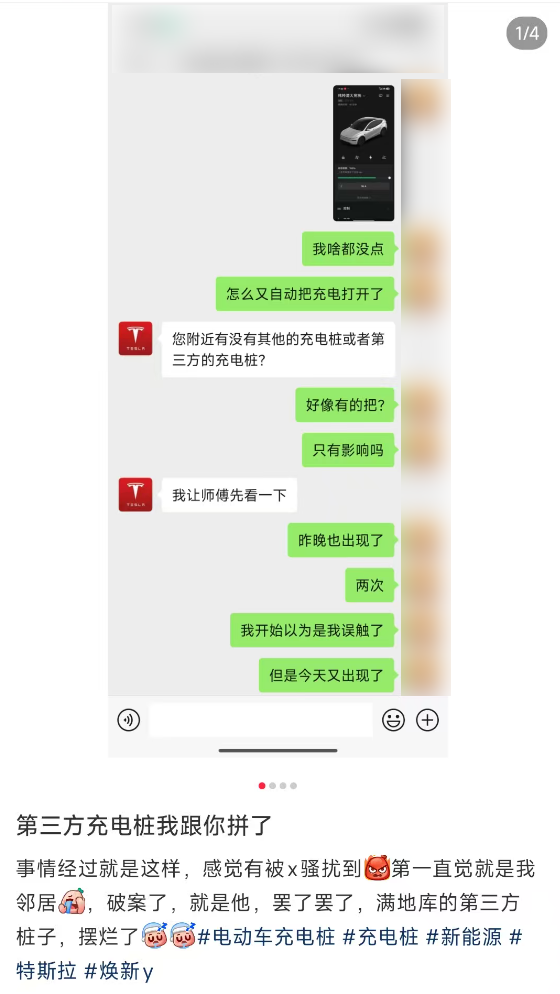
And then there’s a more peculiar, firsthand account – last week, while traveling, my colleague, driving a Model 3, planned to pull over to switch drivers. Unexpectedly, the charging cover popped open on its own…
This sudden opening startled a pedestrian passing by the charging port, nearly causing an accident.

Although this incident likely has nothing to do with remote opening, it further deepened my colleague’s negative perception of Tesla’s charging cover.
So, why can Tesla’s charging port be opened so easily?
After some research, I discovered that the design of Tesla’s charging port has a rather “interesting” explanation.
Tesla owners might know that the official Tesla charging gun has a button. Pressing it opens the charging port.

It’s a clever design, isn’t it? I used to think it was some kind of “black technology” from Tesla.
However, I now understand that this button, and the “toy” device, both operate on the same principle: a simple radio frequency (RF) signal transmitter button.
When pressed, the internal signal generation module emits an RF signal at a frequency of 434 MHz (or 315 MHz in North America).
Teslas within range that receive this signal will open their charging ports. There is no signal encryption; it’s an open broadcast, and the signal is easily captured. Yes, it’s as straightforward and unadorned as it sounds.

Upon disassembling the “toy” device used by my colleague, you’ll find it’s not high-tech at all.

Furthermore, a few years ago, a user on GitHub shared the control code for opening Tesla charging ports remotely. It’s practically an open secret…

Additionally, compared to the small “toy” mentioned earlier, some charging stations actually have a more powerful transmitter. For instance, a Bull charging station, when that signal-emitting button is pressed, can open the charging port of a Tesla within ten meters.
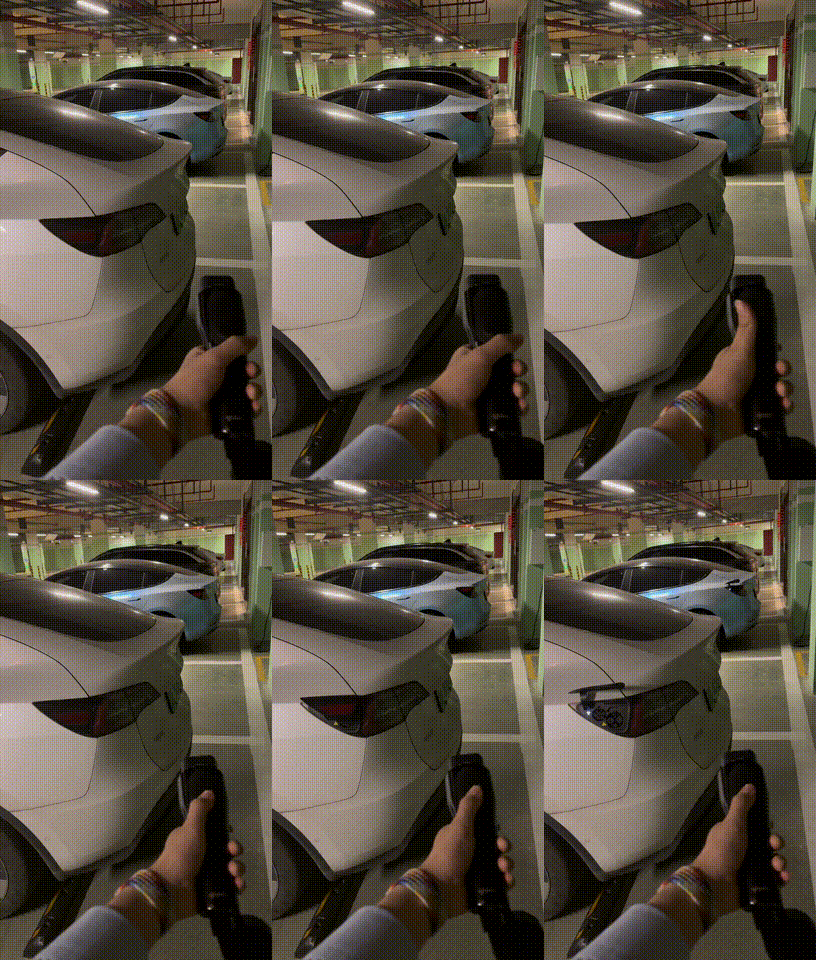
No wonder this brand is called “Bull” and not “Private Bull”…

Tesla enthusiasts, please don’t think I’m trying to disparage Tesla. To be fair, I highly doubt Elon Musk is unaware of the potential risks associated with this design.
Therefore, it’s highly probable that this is a compromise Tesla made between “convenience” and “security.”
On the upside, this operation is indeed very convenient – you don’t even need to unlock the car. Simply pressing a button on the charging station allows you to open the charging port and begin charging.
This feature even facilitates the practice of drivers plugging in charging guns for other Teslas that are occupying Supercharger spots for extended periods, helping them accrue parking fees.
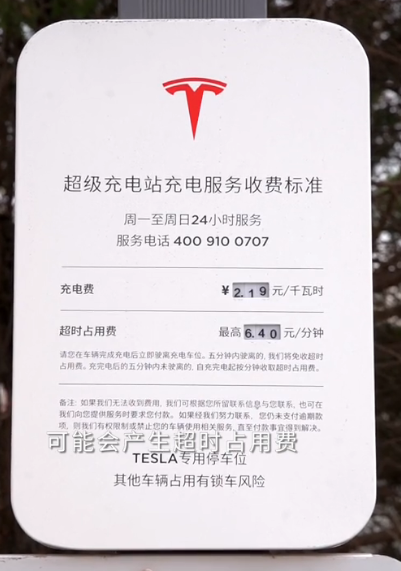
In this regard, people both domestically and internationally share a common warmth and helpfulness.


For third-party manufacturers, it is easier to develop charging piles compatible with Tesla. The more charging stations that are compatible, the more likely Tesla vehicles will be chosen by consumers.
The drawbacks, as mentioned at the beginning, primarily involve the risk of damaging the charging port and cover, posing a threat to driving safety.
Let’s first consider the issue of water ingress into the charging port. Although national standards stipulate the waterproof rating for new energy vehicle charging ports, Tesla’s charging ports achieve an IP67 rating.
GB/T 20234.3-2015

However, don’t be misled by videos that show water being poured into charging ports. A mechanic who frequently repairs Teslas informed us that “normal rain exposure won’t immediately cause issues, but long-term corrosion is the most severe problem…”

Even though the metal contacts in the charging port have strong anti-corrosion properties, they cannot withstand prolonged exposure to rainwater.

At this point, not being able to charge is a minor issue. A short circuit leading to overheating and fire, or damage to the high-voltage wiring harness within the vehicle, would be a much more serious consequence.
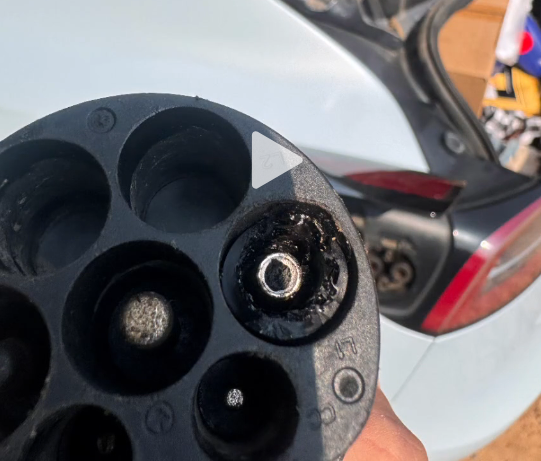
I once used a charging head that had been urinated on to charge my ET5T. After charging, the vehicle’s large screen displayed a “Vehicle Insulation Weakened” warning. Fortunately, the car could still be driven, so I immediately took it to the repair shop after consulting NIO’s after-sales service.
The corrosion wasn’t severe, and the mechanic cleaned up the charging port, after which the warning disappeared. However, in cases of severe insulation weakening, the vehicle may become undriveable.
Illustration of “Vehicle Insulation Weakened” warning in other NIO vehicles

Furthermore, there’s the issue of foreign object obstruction. If anyone can easily open the charging port and insert something, it could prevent you from even plugging in your charging gun…
So, the question arises: can domestic Chinese new energy vehicles also have their charging ports remotely opened as easily as Teslas?
To give you the answer upfront: generally, no, due to different opening mechanisms.
Domestic new energy vehicle charging port opening methods can be broadly categorized into touch-and-press and Bluetooth network types. Some vehicles may also offer both.

From a technical standpoint, both touch-activated and encrypted Bluetooth mechanisms are significantly more secure than Tesla’s method, making it difficult for unauthorized individuals to open these charging ports.
Moreover, most domestic electric vehicles come equipped with rubber caps, which is a thoughtful addition.
In summary, if not for my colleague’s recent demonstration, the Tesla owners in our office wouldn’t have even realized this issue. Even now, despite some lingering unease, they tend to believe that “convenience outweighs the risk,” without fully comprehending the potential hazards of this charging port opening design.
Therefore, we hope that Tesla will implement a simple upgrade to introduce a charging port opening solution that balances both convenience and security.
For instance, a simple OTA update to the vehicle’s software or charging stations could involve algorithmic encryption and decryption of the RF signal, enabling a form of “one charging station per one car” within a certain range.
While this might slightly increase the opening time, it would significantly enhance security. I believe Tesla owners would welcome such an improvement.
