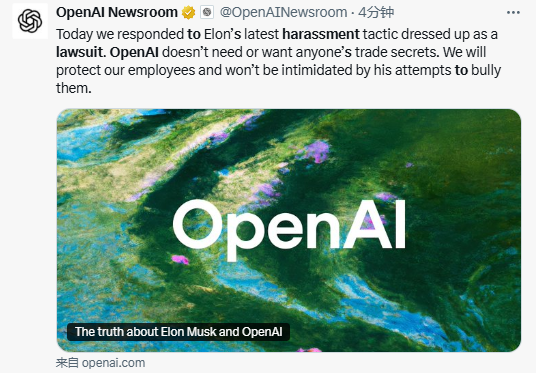
October 3rd, Beijing time, OpenAI has officially responded to Elon Musk’s lawsuit through its official news account. The company stated, “OpenAI does not need and does not want anyone’s commercial secrets. We will protect our employees and will not be intimidated by Mr. Musk’s attempts to bully them.”
According to media reports, last week, xAI, founded by Elon Musk, filed a lawsuit in the U.S. District Court for the Northern District of California. The lawsuit accuses OpenAI of systematically and premeditatedly poaching its employees and illegally stealing commercial secrets.
xAI’s filing claims that OpenAI has been engaging in “deeply disturbing patterns” and “strategic actions.”
These actions reportedly involve deliberately inducing employees to violate confidentiality agreements, with the intention of acquiring xAI’s source code, operational advantages in data center startups, technological advancements, and strategic business plans. The ultimate aim is to gain an unfair advantage in the fiercely competitive field of advanced AI development.
This lawsuit marks the sixth legal battle initiated by Elon Musk against OpenAI in the past eighteen months. The disputes have escalated from California state courts to federal courts, with the accusations becoming increasingly severe, evolving from initial claims of breach of contract and unfair competition to allegations of monopolistic practices and, most recently, the theft of commercial secrets.
Musk’s public comment on this particular lawsuit was: “I have tolerated enough, and will tolerate no more.”
Today, OpenAI characterized this case as part of Musk’s “ongoing harassment” of the company.
OpenAI has denied xAI’s accusations, asserting that their claims are both false and lack evidentiary support.
“Under Mr. Musk’s leadership, talented employees from xAI are leaving in droves, with some choosing to join OpenAI to help advance our mission,” the legal documents stated. “These employees are fully entitled to choose their future employment, and OpenAI is entitled to hire them.”
The current legal confrontation highlights the intense competition and high stakes in the race for AI dominance. Musk’s aggressive legal strategy suggests a deep concern over the potential misuse of proprietary information, while OpenAI’s firm defense underscores its commitment to protecting its autonomy and talent acquisition practices. This ongoing saga is likely to have significant implications for the future development and ethical considerations within the AI industry.