
Recently, a residential building in Jinhua, Zhejiang, gained attention online. A blogger casually shared a post about the building being covered in a climbing plant. Some netizens pointed out that it appeared to be water spinach. Upon further confirmation, the blogger verified that it was indeed water spinach.

This confirmation sparked widespread discussion online, with many netizens expressing curiosity about how water spinach could grow in such a manner on a building.
Recalling childhood experiences in vegetable patches, I’ve seen water spinach bloom. In my opinion, this plant is a decorative species overshadowed by its culinary utility. Its flowers are as follows:

△ Water Spinach Flower
One can imagine how beautiful it would be when this water spinach, growing like in the Jinhua case, reaches its blooming period. Furthermore, water spinach has a long flowering season, typically from July to September.
What does the shape of water spinach flowers remind you of?
Interestingly, water spinach shares a very famous and common ornamental relative: the morning glory.

△ Morning Glory
The image above shows a morning glory flower. Its shape is strikingly similar to that of a water spinach flower, both being trumpet-shaped. The primary difference lies in the more vibrant and diverse colors of morning glories, a result of domestication.
Both water spinach and morning glories belong to the order Lamiales, family Convolvulaceae, genus Ipomoea. Their close genetic relationship explains the similarity in their blooms.
“Genus Ipomoea”?
Indeed! Sweet potatoes also fall under this genus. If you’ve ever seen a sweet potato plant flower, you’ll easily understand their connection.

△ Sweet Potato Flower
Most plants in the Convolvulaceae family are vines. To compete for sunlight, they exhibit rapid growth and tend to twine around other plants or structures for support.
If water spinach is not harvested for consumption, it will naturally begin to vine outwards, its stems will gradually lignify, and it will eventually flower and bear fruit.
Therefore, the extensive vine growth observed on the building in Jinhua is a normal characteristic of water spinach when allowed to grow freely without harvesting. However, at this stage, its edibility might be compromised.
In tropical regions, water spinach is perennial. In most parts of China, however, it is an annual plant, typically dying off during the coldest parts of winter. Even in Wenzhou, the southernmost part of Zhejiang, it is considered an annual.
Consequently, the water spinach covering the building in Jinhua has likely finished its flowering season and will soon succumb to the winter cold.

What Kind of Plant is Water Spinach?
The true name for water spinach is “wèng cài.” In the Minnan dialect, the pronunciation is quite similar to the Mandarin “wèng cài.”
I’ve noticed that many things that are easily articulated in dialects like Minnan are often ancient in origin.
The cultivation of water spinach in China dates back a very long time. The earliest written record can be traced to the Western Jin Dynasty, in Ji Han’s “Nanfang Caomu Zhuang,” which states: “Wèng, its leaves are smaller than Malabar spinach. It is cold in nature and sweet in taste. Southerners weave reeds into rafts, create small holes, and float them on water.”
This passage indicates that in ancient times, people in southern China cultivated water spinach in water, suggesting it might have originally been a semi-aquatic plant.

You’ll observe that aquatic plants often share two characteristics: hollowness and rapid growth!
The hollow structure in aquatic plants is generally attributed to the need to provide buoyancy for their tissues, preventing submersion, and to facilitate the transport of oxygen to their submerged parts.
Furthermore, aquatic environments tend to provide a richer supply of nutrients, leading to faster growth rates. Rapid growth means that a larger proportion of the stems remains unlignified, contributing to their tender and succulent texture.
Ancient people were likely drawn to water spinach’s fast growth and tender stems. This led to experimentation with its cultivation and consumption, gradually domesticating it into a more palatable “everyday vegetable.”
Even today, the nutritional value of water spinach is seldom highlighted, despite its significant benefits. Its cultivation is primarily driven by its ability to regrow quickly after harvesting.

△ Water spinach is remarkably easy to grow hydroponically.
In Conclusion:
Speaking of domestication, water spinach, sweet potatoes, and morning glories from the genus Ipomoea serve as classic examples of plants that, while sharing a common ancestry, have diverged significantly under human influence.
Initially, water spinach was likely not as well-suited for culinary purposes, its appeal stemming from its tender stems and leaves. Through human intervention, it has evolved into the delicious vegetable we know today.
Sweet potato tubers were certainly not as large in their wild state. However, upon discovering their edibility, humans, through selective breeding, have cultivated them to achieve their current impressive size.
Morning glories, on the other hand, possessed far less diverse flower colors historically. Their cultivation for ornamental purposes by humans has led to the development of varieties with a dazzling array of colors.
The profound impact of human domestication and selective breeding on plants, leading to dramatically different outcomes, reminds me of another remarkable example: the cabbage family, which has been so profoundly “modified” it’s almost unrecognizable from its wild ancestor.
This family is the Brassica oleracea, commonly known as kale or wild cabbage!
Many of the vegetables we find in supermarkets today are actually different cultivars of Brassica oleracea.

△ Cabbage, also known as headed cabbage – Scientific name: Brassica oleracea L. var. capitata L.

△ Cauliflower, also known as cauliflower – Scientific name: Brassica oleracea L.var. botrytis L.

△ Broccoli, also known as green broccoli – Scientific name: Brassica oleracea L.var. italica P.

△ Brussels sprouts, also known as bud cabbage – Scientific name: Brassica oleracea L.var. gemmifera Zenk.

△ Kale, also known as ornamental cabbage – Scientific name: Brassica oleracea L.var. acephala DC.
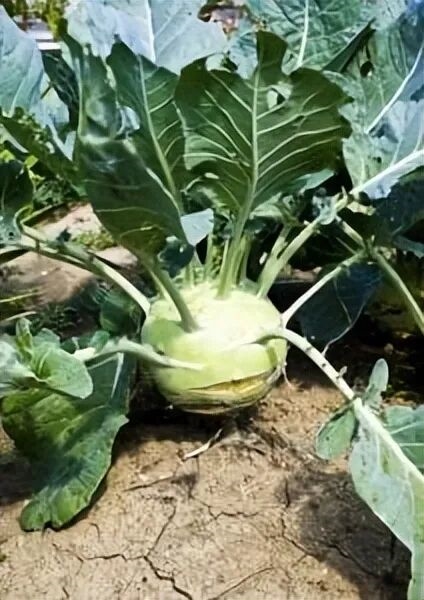
△ Kohlrabi, also known as turnip cabbage – Scientific name: Brassica oleracea L.var. caulorapa DC.

△ Gai lan, also known as Chinese broccoli – Scientific name: Brassica oleracea L.var. alboglabra Bailey
……
From their scientific names, it’s evident that these are all variations of Brassica oleracea. They exhibit diverse appearances, and we consume different parts of them—ranging from roots and stems to leaves, buds, and even flowers.
By focusing selective breeding on the parts we consume, we have enhanced their palatability, ultimately creating these seemingly distinct varieties.
And below is the wild ancestor of Brassica oleracea:

