
This year’s Double Eleven felt a bit off. Doesn’t it seem unusually quiet to everyone?
The promotional periods are stretching longer and longer, it feels like a Double Eleven sale has already quietly begun without us realizing it.
While there were opening sale announcements and GMV (Gross Merchandise Volume) reports from various platforms, they lacked the usual overwhelming, “bombardment” feel of previous years.

Even the mind-boggling discount rules and red envelope games seemed to have toned down significantly this year.
Of course, part of the reason might be that with the extended sales period, our excitement has been diluted.
However, to assume that e-commerce platforms and merchants have become “zen” is simply impossible; they’ve just found new ways to compete fiercely.
The keyword this year is AI.
Let’s take a look back. Since the concept of Double Eleven emerged, it has evolved through many iterations. The earliest Double Eleven was straightforward: log onto Taobao at midnight on November 11th and simply buy, because it was genuinely 50% off everything.
But later, Double Eleven evolved into a battleground for multiple platforms. A campaign that could have concluded in 24 hours was stretched to an entire month. Looking back in hindsight, Double Eleven has become a veritable “cyber-year ring,” where major trends like the mobile internet revolution, industrial upgrading, and consumption changes are all mirrored year by year.
This year, although the fanfare on the surface has diminished, the intensity of behind-the-scenes competition among merchants has not lessened at all. Especially with the integration of AI, the battle has escalated on all fronts.
Taking advantage of Double Eleven, our team at “Criticism” (差评君) also spoke with some merchants. It turns out that when preparing for the major sales, AI was surprisingly busier than people.
Initially, I thought these merchants’ use of AI would be limited to writing copy or generating a few promotional posters. However, I was surprised to find that AI’s implementation in the e-commerce industry has arrived faster and penetrated deeper than we imagined.
Let’s start with a striking example: do you think only new tech startups are playing with AI? That’s a narrow view.
Most people have probably heard of Oppein Home; it’s a veteran player in the home furnishings sector, and they’ve been keeping up with the trends by embracing live streaming.

They currently have over 300 dealers actively live-streaming, which is quite an operation. But you might not imagine how rudimentary their previous live-streaming management methods were.
Let me describe their operational routine: one person was responsible for managing the live-streaming accounts of 10 dealers. Dealers would flood them with requests and questions: “Applying to go live on X date, budget XX,” “How is the data for this stream?” “How much ad budget is left?” The poor operator was overwhelmed.
Because all live-streaming schedules and advertising budget allocations were managed through group chats and constant mentions, more messages often led to a chaotic situation where messages were seen but not properly responded to.
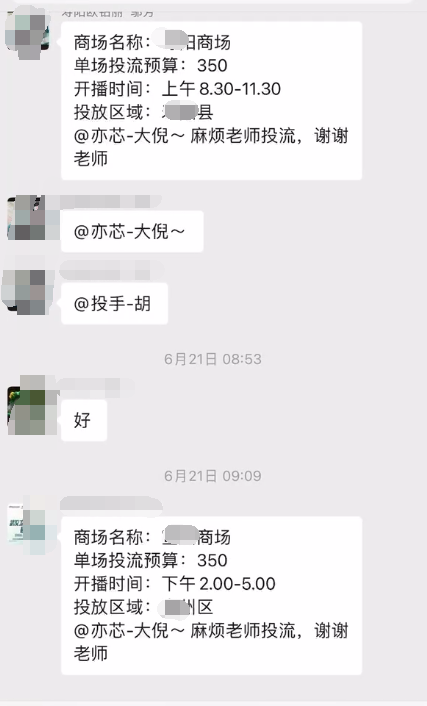
After the live stream, data had to be manually extracted from the backend, saved into local folders, and then repeatedly copied, pasted, and sent as messages to whoever needed it.

With scattered data, decision-making became slow. If a supervisor asked for a review, you’d have to say the data was in an operations person’s local D drive. Furthermore, Excel spreadsheets could only tell you “what happened,” not “why it happened,” let alone “what to do next.”
However, in today’s intensely competitive e-commerce landscape, success hinges on precise product selection, rapid campaign deployment, and thorough post-event analysis. If you can’t even compile complete data and your decisions are lagging, how can you compete?

Oppein Home quickly realized their need for AI.
But there’s a catch: AI can’t understand the “OK” and “Received” messages scattered across various group chats, nor can it be expected to access screenshots and Excel files stored locally.
This, in fact, is one of the barriers to AI implementation in the e-commerce industry. After all, you first need to consolidate all the fragmented and disorganized business information and then transform it into structured data that AI can comprehend.
Therefore, Oppein Home needed a system that could bridge the gap between business operations and AI.
According to Oppein Home, they experimented with Feishu’s Lark Suite (飞书多维表格) this year to build a live-streaming management system. Since integrating Lark Suite, the entire approach to live-streaming for their dealers has transformed. All dealers now fill out their live-streaming dates, budgets, and time slots in a single form. This information is automatically aggregated and categorized within Lark Suite, making it clear who is streaming, who is about to stream, and so on.

Even the task of extracting data is no longer a manual chore. Lark Suite activates RPA (Robotic Process Automation) robots to capture data directly from the dealers’ live-streaming dashboards.

At this point, AI begins its work. After analyzing screenshots, it summarizes advertising expenditure and live-streaming performance, automatically populating the relevant fields in the table.

Now, managing 30 live-streaming accounts is no longer an issue, let alone just 10.
So you see, while a couple of years ago people talked about AI lacking direction for practical application, now, through integration with Lark Suite, AI has truly sparked innovation in e-commerce.
Of course, just using Oppein Home as an example might not be enough to fully grasp how AI is transforming the industry. We need a more comprehensive view.
Firstly, AI’s most direct impact is freeing people from mechanical, repetitive tasks, allowing individuals to achieve the output of a team.
It’s no exaggeration: let’s look at the case of “Jiaonei” (蕉内) preparing for Double Eleven. The sheer volume of visual design requests alone can be overwhelming.

Operations staff painstakingly write requirement documents and send them to designers. After the designers schedule and create the visuals, a round trip could easily take two working days to get a design finalized—if you’re lucky.
But with AI, operations staff can now act as quasi-designers.
By inputting basic product images and style references into Lark Suite, and then listing all design requirements, AI can generate design drafts based on specific needs.

For instance, an operations person might want to place the outfit on the left onto the model on the right.

After three rounds of processing, AI can not only change the model’s clothes in 10 seconds but also add promotional information and even logos with a single click. Can you really beat that for efficiency?

Changing underwear colors or having a model hold a shopping basket can all be achieved without physical photoshoots or Photoshop. Operations staff can independently generate numerous versions of product designs using AI.
The live-streaming company “Jiaoge Pengyou” (交个朋友) is also seeing enhanced individual capabilities thanks to AI.

A single live stream for Jiaoge Pengyou requires writing 500 benefit points like these. While the task sounds simple, it’s extremely taxing. These benefit points must align with product features, comply with platform rules, and not exceed 36 characters. This usually requires three specialized individuals working 12 hours a day, leaving them utterly drained.
However, since February of this year, Jiaoge Pengyou has become smarter. Based on Lark Suite, they’ve trained AI to learn from past best-selling points and successful cases, enabling it to generate a batch of benefit points that meet the requirements.
While not every point may be perfect, AI, at this stage, can at least ensure that benefit points are at a passing standard while maintaining efficiency and accuracy.
Currently, a single person at Jiaoge Pengyou can complete 500 benefit points in just 25 minutes, and these 25 minutes are spent on refining and optimizing, rather than starting from scratch.

However, it must be said, if AI only boosts individual efficiency but the workflow remains the same, bottlenecks will still occur.
So, is there a possibility that AI can help us optimize business processes?
The answer is a resounding yes, and the e-commerce industry is already applying it.
Historically, most companies’ e-commerce operations ran on a chaotic system: a combination of group chats, Excel spreadsheets, human memory, and empirical guesswork. Take Atour Planet’s (亚朵星球) influencer management, for instance. To evaluate an influencer, an operator would need to open several platforms like Chan Mama and Xingtu, sometimes up to 80 web pages simultaneously, straining their eyes.

And it doesn’t stop there. If you need to push a project forward, there’s no centralized place to track task progress, project status, or who is responsible. Forget about the manual compilation of influencer evaluations and post-campaign reviews.
Faced with high-speed business growth demands, Atour Planet’s solution was to cut through the complexity. They meticulously reviewed all aspects of influencer management and consolidated everything into a single table.

Constantly switching between multiple web pages to collect influencer data? No problem. They now use APIs and RPA as digital couriers to automatically fetch scattered data from various platforms and populate the table.
The lack of clear project progress in the past was due to information silos. Atour Planet leveraged Lark Suite to display all processes and project statuses on a single comprehensive table, making it immediately clear who is doing what and at what stage.
Post-campaign reviews have also become much more streamlined.
Operators simply need to set up what content related to the brand to capture and when to capture it. Lark Suite can then automatically scan the entire web for content, and even provide clear calculations for engagement metrics and conversions.
This way, data is no longer fragmented but unified and manageable.
After our discussions, it’s clear that Lark Suite is more than just a spreadsheet; it’s a business system that empowers AI to function effectively.
If AI represents the future of e-commerce, then Lark Suite is helping everyone embrace that future.
From emerging MCN agencies to traditional home furnishing giants, companies are collectively choosing to reshape their operations with Lark Suite.

Their pursuit is not merely operational efficiency but an evolution of their business model. After all, in the e-commerce industry, success depends on who can seize market opportunities faster and whose decisions are more accurate.
In the past, e-commerce was driven by experience: product selection relied on intuition, and decisions were based on gut feeling, undeniably containing an element of gamble.
What AI can do is distill experience and methodologies into a system like Lark Suite, providing businesses with greater certainty in their decision-making processes.
This, perhaps, is the most profound change AI brings to the e-commerce industry.
Of course, turning back to us consumers, we hope that since merchants are using AI behind the scenes, they could refrain from tormenting us with overly complex promotional mechanics.
Offer discounts when they should, make profits when they should, and above all, be more sincere and less gimmicky.
