Creating realistic film sets no longer requires significant budgets for physical constructions or painstaking post-production efforts with green screens.
My recent visit to iQIYI’s virtual production studio in Hengdian in August revealed just how advanced television filming technology has become.

A scene set in a grand Golden Dragon Hall appeared incredibly majestic on screen. However, aside from a few physical props like banners, lanterns, candlesticks, tables, and other small items, the entire hall, including the statues of celestial kings and the dragon-entwined pillars, was simulated.
More precisely, the visuals were entirely rendered on an LED screen.
This technique, where a massive LED screen displays real-time backgrounds for filming and creative production, is known in the industry as virtual production or virtual shooting.
While it sounds quite sophisticated, it essentially involves rendering digital assets, such as the Golden Dragon Hall, in real-time using virtual engines like Unreal Engine, and then projecting these rendered scenes onto the LED screen.
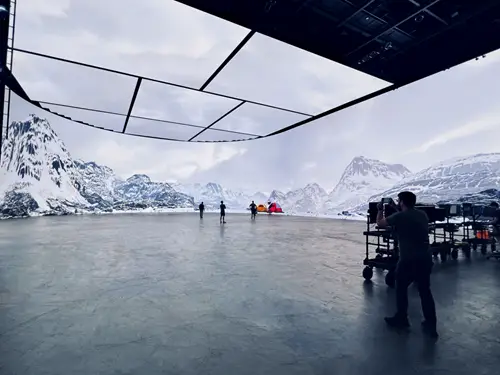
For instance, iQIYI’s virtual production studio features a 225-degree curved LED screen, with actors performing on a circular electric turntable in front of it.

However, simply displaying a static image as a background would lead to obvious visual discrepancies in perspective if the camera were to move even slightly. This would break the illusion.
To overcome this, each camera is equipped with sensors that track its dynamic position. The rendering engine then dynamically adjusts the background scenery in real-time based on the camera’s movement, projecting the corresponding visuals onto the LED screen.
As the camera moves forward, the pillars on the screen would appear to grow larger, and shifting the camera to the left would allow it to move around the pillars, revealing their sides, for example.
On-site, it was remarkable to observe that while the LED screen itself might appear slightly detached to the naked eye, the footage viewed through the camera essentially showed no discernible flaws.
It’s worth noting, however, that virtual production technology itself is not entirely new.
When “The Mandalorian” premiered in 2019, more than half of its scenes were filmed in front of LED screens, significantly bringing virtual production into the mainstream spotlight.

Following this breakthrough, the global film and television industry experienced a seismic shift.
Disney, the parent company of “The Mandalorian,” having witnessed the success, quickly established several more virtual production studios in locations like Los Angeles and London.
Other major studios, such as Warner Bros. and Netflix, eager not to fall behind, responded by either investing heavily in building their own studios or leasing existing ones at premium rates. This surge in adoption led to several major Hollywood blockbusters between 2020 and 2022, including “Thor: Love and Thunder” and “The Batman,” utilizing this innovative technology.

Domestically, the competition is equally fierce. iQIYI relocated its virtual production base from Dachang, Hebei, to Hengdian to build a virtual shooting studio. Tencent Entertainment constructed a 3,000-square-meter LED virtual studio, and Youku operates the Zhenxiang Digital Studio within the Zhouzhuang Digital Dream Factory. Additionally, the Wuxi National Digital Film Industrial Park houses a massive LED screen, reportedly the largest cinema-grade panoramic shooting screen in the country.
Several specialized film and television companies focused on virtual production also possess their own large LED screens. For instance, parts of the post-production scenes for the widely popular drama “Blossoms Shanghai” were enhanced through a collaboration with Shanghai Burning Sugar Culture, employing virtual production techniques.

To put it into perspective, Unilumin Group, a key upstream supplier of LED screens for virtual production, has seen its sales skyrocket. Most of the renowned virtual production studios domestically and internationally feature their products.
So, why are major platforms like iQIYI, Youku, and Tencent so invested in this technology?
One commonly cited benefit is the direct impact on cost reduction and efficiency for film crews. It eliminates the need for large teams to travel extensively for location shoots and significantly cuts down on the expense of building elaborate physical sets.
While this statement holds true, it represents only the surface-level advantages.
Have you ever heard of the “magic hour” in photography and filmmaking? This refers to the brief, fleeting 20-30 minute periods around sunrise and sunset when the light is most ethereal and dramatic.
The challenge is, how can one consistently capture these precious moments?
Renowned director Terrence Malick, in his pursuit of absolutely perfect natural lighting for his film “Days of Heaven,” insisted on shooting exclusively during the magic hour. This undoubtedly led to an exceptionally long production schedule.

Virtual production, in essence, brings the “gods of light” into the studio. The LED screen can meticulously recreate any lighting condition, from the golden hour to atmospheric volumetric lighting effects (Tyndall effect).
Previously, with green screen filming, actors relied heavily on their imagination for non-physical performances. Whether the lighting was accurate or the atmosphere was captured effectively, these would only be known during post-production, introducing a high degree of uncertainty.
Virtual production, however, champions a “what you see is what you get” approach.
During my visit to Hengdian, I had the opportunity to speak with Director Zheng Weiwen (known for works like “The Untamed” and “Blazing Flame”), who repeatedly emphasized the “what you see is what you get” benefit of virtual production.
Lighting is another critical aspect. When shooting against a green screen, post-production effects must also account for the on-set lighting. In contrast, with virtual production, the background and on-set lighting can interact dynamically and complement each other.

Furthermore, virtual production is fundamentally reshaping the entire filmmaking process.
Yuan Xin, a producer on “The Shadow Hunter,” explained that traditional pre-production workflows were sequential and cumulative. This involved script confirmations, director’s visions, art department selections, concept art approvals, main creative team sign-offs, budget allocations, set and prop design, and lighting arrangements, all happening in a step-by-step manner.
However, virtual production significantly compresses these stages, allowing many tasks to be executed concurrently. The exhilaration of filming that arises from integrating post-production creative visions into the early stages of production is something that cannot be quantified.
Of course, while the future prospects of virtual production are undeniably bright, the current application of this technology in China has not yet become widespread.
At present, film crews utilizing virtual production are primarily involved in costume dramas and fantasy genres, with a less frequent application in realistic productions. Projects that have adopted virtual production are often those independently produced, co-produced, or closely affiliated with major streaming platforms.

One reason for this limited adoption is that many film crews, particularly those in the mid-tier and below, are still unfamiliar with this novel workflow, and it’s not always an indispensable technology for them.
However, a more significant factor, in my opinion, is the cost.
Taking iQIYI as an example, before their price reduction this year, their virtual production studio cost a substantial 160,000 yuan per day.
Assuming a conservative shooting schedule of 30 days, this alone would incur nearly 5 million yuan in expenses related to virtual production.
Fortunately, a significant price adjustment in June brought the daily rate down to 35,000 yuan, leading to a noticeable increase in collaborations with mid-tier film crews for iQIYI.
Overall, I am optimistic about the application prospects of virtual production technology in China. More accurately, I am optimistic about the technology’s inherent value: its core lies not in cost reduction, but in dramatic efficiency enhancement.
I’ve also learned that some film crews are beginning to leverage generative AI to assist in creating less complex scenes.
Ultimately, whether it’s LED screens or AI, the overarching goal is to liberate film crew members from tedious industrial processes, allowing them to focus more on the aspects that truly require their time and expertise:
Refining scripts, honing acting skills, and telling compelling stories.