
苹果Mac用户本地运行大模型的围墙,正在被Google亲手推倒。当行业还在争论16GB内存够不够塞下70B模型时,Google直接把12B旗舰模型塞进了轻薄本,而且跑得飞起。这背后不只是技术迭代,更是一场关于「端侧智能」话语权的暗战——云厂商正试图让用户彻底摆脱云端,把AI能力焊死在本地芯片上。
Apple Mac users are facing a further reduction in the threshold for running generative large models offline locally. According to the latest technical updates, Google’s experimental application
Unlike industry common general-purpose third-party open-source model management platforms such as Ollama and LM Studio, Google’s newly launched
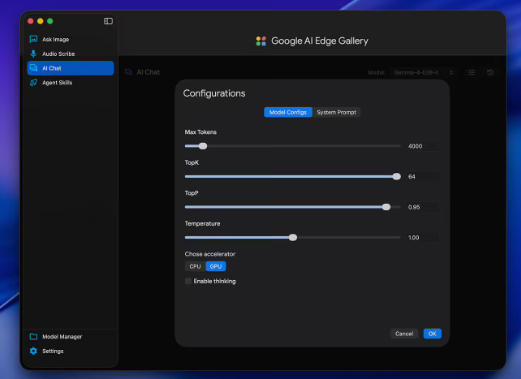
Among these initial models, the one most closely watched by the industry is the flagship edge-side model Gemma412B with 12 billion parameters. Google stated that thanks to the deep adaptation of the underlying architecture with macOS, this model can process multi-modal inputs such as text, vision, and audio extremely smoothly on a regular Mac computer with 16GB of memory. Its excellent local code writing and logical analysis capabilities can instantly turn a lightweight notebook into an offline intelligent agent with round-the-clock multi-modal interaction.
Aside from expanding the core model library, Google also released a free edge-side voice efficiency tool for the Mac ecosystem — Google AI Edge Eloquent. This tool focuses on offline intelligent transcription services, not only accurately capturing and transcribing users’ voice information but also removing filler words and verbal slips in real-time locally, and performing light polishing on the text, thus converting spoken expression into clearer written content.
To completely eliminate the problem of traditional transcription software misinterpreting specific professional fields, Eloquent also offers a “custom vocabulary list” function. Users can input their personal names, specific industry terms, and daily frequently used phrases in the software according to their needs. Since all voice analysis and text polishing processes are completed in a closed loop on the Mac’s local chip, data does not need to be uploaded to the cloud, greatly meeting the rigid protection requirements of professionals regarding data privacy and business confidentiality.
不过,这套「全家桶」打法也存在隐忧。AI Edge Gallery目前仅支持Google自家模型,且首批只有5个,生态封闭性远不如Ollama。对于想尝试Llama、Mistral等第三方模型的用户来说,这扇门暂时还是关着的。但换个角度看,Google选择在macOS首发而非Windows,或许暗示着端侧AI的新战场——苹果的Metal GPU和统一内存架构,天生就是大模型落地的优质土壤。当巨头开始为特定硬件深度定制,行业壁垒将不再只是参数大小,而是芯片与模型之间的耦合效率。