
The hottest topic today, without a doubt, is the confrontation between Luo Yonghao and Xibei.
If you haven’t caught up yet, don’t worry, I, Cha Ping Jun, will give you a brief rundown.
On the 10th, Luo Yonghao posted on Weibo, alleging that Xibei uses prefabricated dishes, which are also overpriced and quite unappetizing. He called for restaurants to be mandated to disclose the use of pre-prepared ingredients.
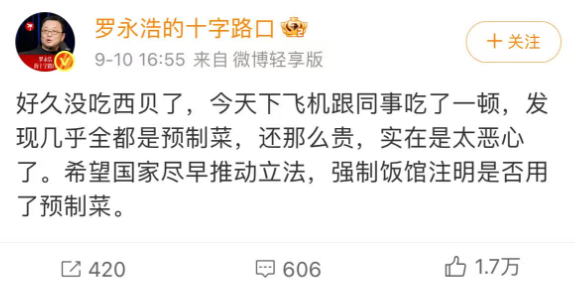

Xibei, with nearly 400 outlets nationwide, is a large and nationally recognized chain restaurant.
Its founder, Jia Guolong, felt he could not tolerate the accusation and publicly responded, stating that “Xibei currently does not use pre-prepared dishes and intends to sue Luo Yonghao.”
Xibei also introduced a series of measures, including launching a Luo Yonghao “same style” menu with 13 dishes, offering direct ordering and allowing for customization. Additionally, they opened up their kitchens, inviting customers to witness the preparation process.
One interpretation of Jia Guolong’s stance is that he believes Xibei is in the right and that escalating the matter could attract significant public attention. Moreover, the trend of business leaders becoming internet personalities has been growing, and Jia Guolong himself has made numerous public statements. This might also be an opportunity for him to cultivate his personal brand, hence his firm attitude.
This has effectively escalated the conflict from a discussion about “prefabricated dishes on the tip of the tongue” to a “Legal New Hour” type of public debate.
Luo Yonghao was not idle either, responding with over 20 Weibo posts. He engaged in giveaways of iPhones and even offered a 100,000 yuan reward for information. He even hosted a live stream to discuss the issue.

Through these rounds of back-and-forth, the issue evolved from Luo’s personal complaint to a nationwide online hot topic, dominating trending lists for quite some time.
Xibei suddenly found itself the target of widespread criticism.
People visited their kitchens, dug up past controversial statements by their CEO, and scoured old news articles about Xibei.

Even Xibei’s official social media accounts faced intense scrutiny.

In my opinion, the root of this controversy is quite simple: people have differing definitions of what constitutes a pre-prepared dish.
Is Luo Yonghao making valid points?
From a consumer’s perspective, if the dish served lacks the “wok hei” (breath of the wok), doesn’t taste like it was freshly stir-fried, and contains pre-prepared components, then expressing dissatisfaction is perfectly reasonable.
However, Xibei’s confident stance isn’t baseless; they do have some foundation for their claims.
To standardize the market, in 2024, the State Administration for Market Regulation led the release of the “Notice on Strengthening the Safety Supervision of Pre-prepared Dishes and Promoting High-Quality Industrial Development.” This notice provided definitions and scope for pre-prepared dishes.
Within this notice, dishes prepared by central kitchens are not classified as pre-prepared dishes.
It’s even possible that Xibei initially believed they had a strong case and were guaranteed to win.

But it is clear that Xibei did not achieve the outcome they desired. Instead, it seems the situation has only worsened.
This is because, in business, compliance with regulations is one aspect, but gaining public support is another. The last entity to learn this lesson seems to have been Zhang Xiaoquan.
Firstly, at this stage, there is considerable debate about what exactly constitutes a pre-prepared dish. Regardless of official definitions, individual consumers often have their own interpretations, which may not align with regulatory guidelines.
For instance, some believe that any dish not made from fresh ingredients and consumed immediately is a pre-prepared dish. The longer a dish can be preserved through food technology, the greater the concern for some consumers.
However, applying this definition broadly would imply that preserved meats, Roujiamo (a type of flatbread sandwich), frozen dumplings, and many items on McDonald’s menu are also pre-prepared dishes, raising questions about their safety. This highlights the ambiguity surrounding the term.

When people hear “pre-prepared dishes,” some immediately think of ready-to-heat meal kits, finding it unacceptable to pay a premium price for what amounts to simply reheating food.
After all, a significant reason people choose to dine out is to experience the chef’s skill, enjoy fresh ingredients, and savor the unique “wok hei.”
Others understand pre-prepared dishes as semi-finished products, where a central kitchen handles the time-consuming initial stages like stewing or simmering ingredients before flash-freezing them for freshness. These are then sent to individual outlets for further processing.

The definition of pre-prepared dishes itself has been a subject of discussion for some time.
In addition to the aforementioned notice, in 2022, the China Cuisine Association, as a leading body, drafted the industry guideline “Pre-prepared Vegetable Product Specification,” which attempted to define pre-prepared dishes.
The primary approach was to categorize pre-prepared dishes based on their degree of processing:
Ready-to-eat: Such as preserved meats, which can be consumed directly upon opening.
Ready-to-heat: This category includes meal kits that only require heating or thawing before consumption.
Ready-to-cook: These are more deeply processed ingredients that require minimal additional cooking upon arrival, like pre-stewed beef brisket.
Ready-to-prepare: Similar to pre-portioned ingredients, where ingredients are pre-cut and packaged, requiring the consumer to do the actual cooking.
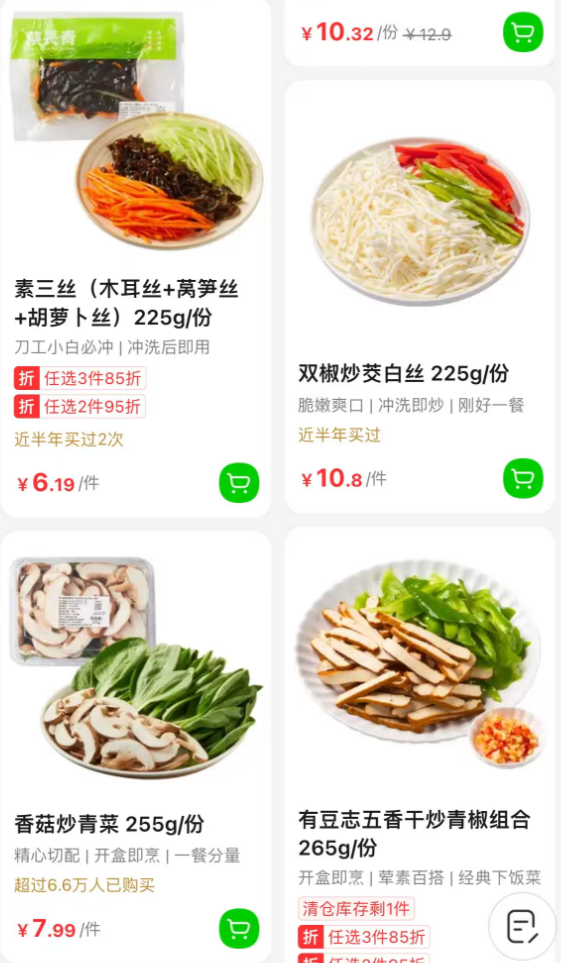
In the absence of a consensus, Xibei’s assumption that this was merely a dispute over the definition of pre-prepared dishes indicates a fundamental misdirection.
Indeed, today, Xibei’s official Weibo account posted a series of nine images, detailing their preparation processes step-by-step, aiming to argue they do not use pre-prepared dishes.
However, upon viewing these, netizens pointed out the use of concentrated broth bases, large bags of tomato purée, and pumpkin purée, questioning if these were not indeed pre-prepared ingredients.
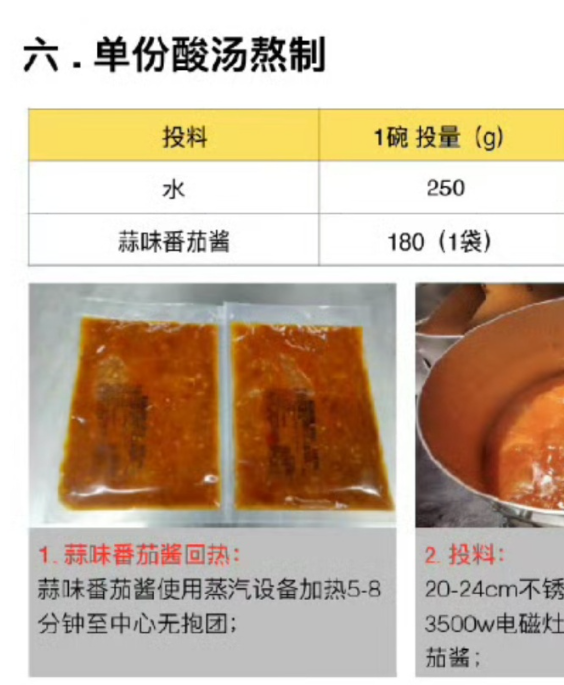
The unfortunate situation for Xibei now is that the more they try to explain, the more they are scrutinized, and the greater the potential for them to be perceived as losing.
Frankly speaking, in the current consumer landscape, there’s only one type of dish that is universally accepted as not pre-prepared.
This involves ordering the dish, the kitchen staff then taking fresh ingredients and stir-frying them in a wok, resulting in an aromatic, piping hot dish served to the table still steaming.

To be direct, Xibei’s true adversaries from the outset have never been Luo Yonghao, but rather the consumers’ long-standing dissatisfaction with the prevalence and lack of transparency surrounding pre-prepared dishes in the catering industry.
The public discussion has moved beyond whether Xibei is right or wrong; instead, Xibei has become a convenient outlet for broader frustrations.
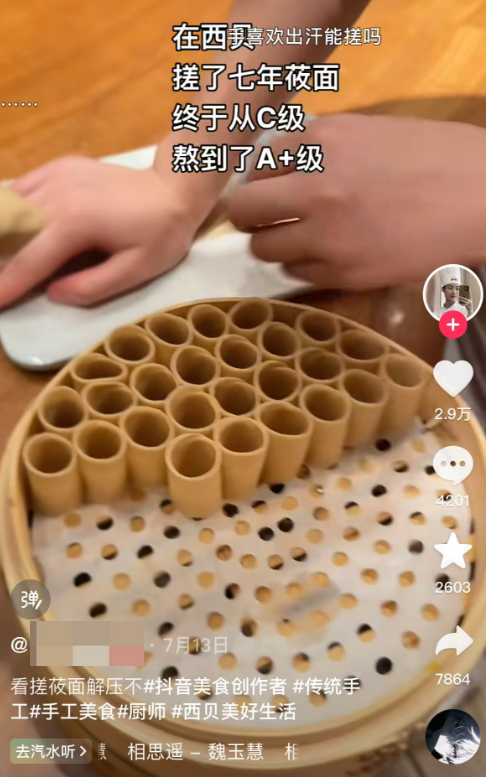
Consider Xibei’s signature product, the Youmian (millet noodles), which are hand-rolled by staff on-site, emphasizing a very artisanal and handmade process, appearing far from pre-prepared.
However, the comment sections under videos showcasing this often feature mockery. Whether the dish is pre-prepared or not is not the core concern for many.
What consumers are looking for today can be summarized by two key aspects: fair pricing and transparency (the right to know).
Either offer dishes at a lower price point, with the convenience of being quick and pre-prepared, or, if priced higher, ensure the dishes are delicious, made fresh, and time-intensive to prepare.
Many catering companies have leveraged central kitchens to industrialize their food production. However, they have failed to pass on corresponding benefits to their customers. While the ingredients may not be as fresh as same-day purchases and costs are reduced, prices have remained unchanged.
Of course, if a company can genuinely command a higher price for its pre-prepared dishes, that is a form of business acumen. However, the prerequisite is complete transparency, ensuring that consumers are willingly paying for the product.

Is it fair that many catering businesses use pre-prepared dishes, charge high prices, yet do not disclose this to consumers?
Take Laoxiangji (a chain restaurant) as an example. Laoxiangji also uses pre-prepared dishes, but their pricing is reasonable, and they clearly label their offerings, giving consumers the choice. This approach has earned them praise.
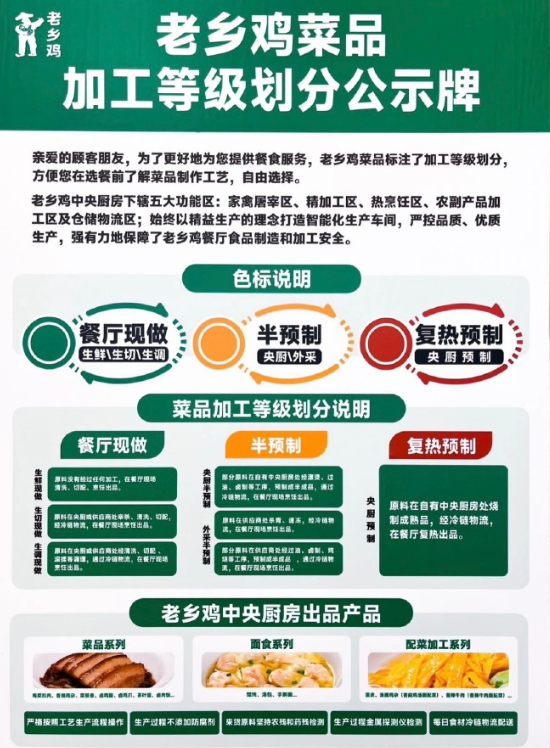
Therefore, I believe Luo Yonghao is quite right on one point: Xibei’s head-on confrontation in this instance might actually be beneficial, as it could potentially push the catering industry toward clearer and more standardized disclosure of pre-prepared dishes.
Consumers do not inherently dislike pre-prepared dishes.
What they dislike is purchasing them with a lack of clarity and transparency.
