On September 15th, according to Kuaikeji, the notion of letting a car drive itself to circumvent drunk driving charges is, to put it mildly, wishful thinking.
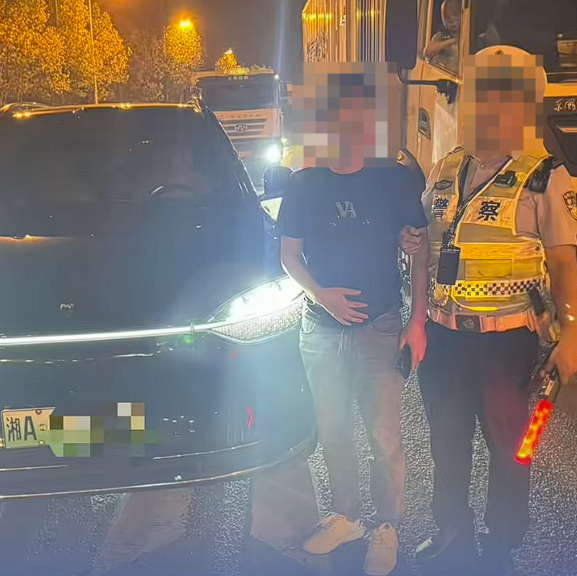
A report from “Changsha Political and Legal Channel” detailed an incident on the morning of September 14th. Traffic police from the Kai Fu Brigade of the Changsha Public Security Traffic Management Detachment were conducting a sobriety checkpoint on the North Second Ring Road.
Around 3:20 AM, a new energy vehicle equipped with intelligent driving assistance approached the checkpoint. As the driver rolled down the window for inspection, a strong smell of alcohol emanated from the vehicle.
Subsequently, the police conducted a breathalyzer test on the driver. The results indicated a blood alcohol content of 225mg/100ml, significantly exceeding the legal limit of 80mg/100ml for drunk driving.
The driver, identified as Mr. Wu, a 41-year-old male from Yiyang, Hunan, admitted to having consumed alcohol. He explained that he had been drinking in Zhuzhou and, after a period of rest, had driven the car back to Changsha entirely using its intelligent driving system, asserting that the car was driving itself. This statement highlights a critical misunderstanding of the capabilities of advanced driver-assistance systems (ADAS). ADAS features, while advanced, are designed to assist the driver and require constant supervision; they are not equivalent to fully autonomous driving systems. Therefore, Mr. Wu’s reliance on the system without active engagement meant he was still in control of the vehicle.
Consequently, Mr. Wu will face severe legal repercussions for suspected dangerous driving. This includes the suspension of his driver’s license, criminal prosecution, and a ban on reapplying for a license for five years. The case is currently under further investigation.