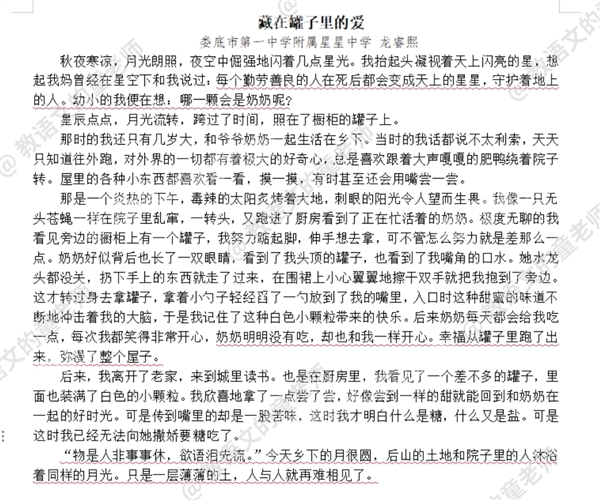
On November 7th, news emerged that a middle school essay titled “Love Hidden in a Jar” has recently garnered significant attention online.
The author of this poignant piece is Long Ruixi, a student from Loudi, Hunan. His essay tenderly recounts memories of his grandmother, who passed away ten years ago. His Chinese teacher, Ms. Tong, was deeply moved by the composition. With Long Ruixi’s consent, she shared the essay on an online platform.

Long Ruixi’s essay includes the evocative line: “Things remain, but people change; everything ceases, and tears fall before words are spoken.” He reflects on the unchanging moon over his rural hometown and the land behind the hills, bathed in the same moonlight as the people in the courtyard. He laments that even a thin layer of soil can create an insurmountable barrier between loved ones, making reunions difficult.
Upon reading the essay, many netizens were moved to tears, with one commenter expressing, “Grandparents give us the most selfless love.” In response to the overwhelming praise, Long Ruixi shared his apprehension about being “praised too highly.”
Ms. Tong expressed her gratitude for the public’s attention and encouragement towards Ruixi. She acknowledged, “We have seen all the encouragement from everyone for Ruixi. For a ninth-grader to write an essay that resonates with so many people, he is truly remarkable.”
Analysis of the Essay’s Impact
The remarkable virality of “Love Hidden in a Jar” highlights the universal themes of familial love and the pain of loss, particularly concerning grandparents. In many cultures, including China, grandparents often play a significant role in a child’s upbringing, providing unconditional affection and wisdom. Long Ruixi’s ability to articulate these profound emotions at such a young age speaks to his maturity and sensitivity.
The essay’s success can also be attributed to its literary merit. The classical Chinese idiom “物是人非事事休,欲语泪先流” (Things remain, but people change; everything ceases, and tears fall before words are spoken) sets a somber and reflective tone, immediately drawing readers into the author’s emotional landscape. His vivid imagery, comparing the moonlight on the land and in the courtyard, further enhances the essay’s evocative power.
Furthermore, the author’s humble response to widespread praise (“怕自己‘被捧得太高’”) is indicative of a grounded individual. This humility likely contributes to the positive reception and admiration from the public, creating a sense of empathy and connection. In an era where online content often prioritizes sensationalism, an essay that touches the heart with genuine emotion and thoughtful reflection stands out, reminding us of the enduring power of simple, heartfelt storytelling.
Ms. Tong’s decision to share the essay and her supportive words for Long Ruixi exemplify the positive impact educators can have on nurturing young talent and emotional intelligence. The essay serves as a powerful testament to how personal experiences, when expressed with sincerity and skill, can transcend individual narratives and resonate deeply with a collective audience.
免责声明:本网站内容主要来自原创、合作伙伴供稿和第三方自媒体作者投稿,凡在本网站出现的信息,均仅供参考。本网站将尽力确保所提供信息的准确性及可靠性,但不保证有关资料的准确性及可靠性,读者在使用前请进一步核实,并对任何自主决定的行为负责。本网站对有关资料所引致的错误、不确或遗漏,概不负任何法律责任。任何单位或个人认为本网站中的网页或链接内容可能涉嫌侵犯其知识产权或存在不实内容时,可联系本站进行审核删除。