
On November 5th, at the “2025 XPENG Tech Day” held in Guangzhou, XPENG Motors unveiled its second-generation VLA large model, dubbed the “Physical World Model.”
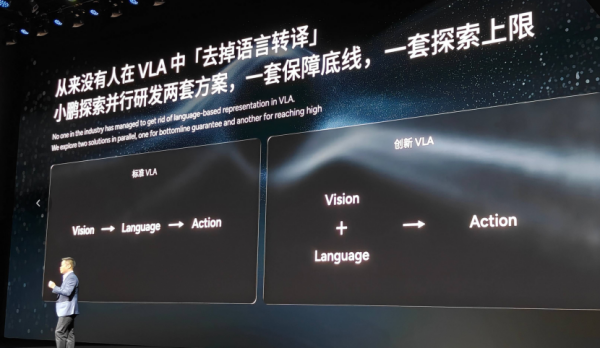
Distinct from prevalent VLA large models on the market, XPENG states that its new model abandons the traditional “Vision-Language-Action” (VLA) architecture’s language translation phase. It achieves end-to-end direct output from visual signals to action commands for the first time, enabling the large model to learn and understand the world akin to humans. This significantly reduces information loss, leading to higher inference efficiency and faster response times.
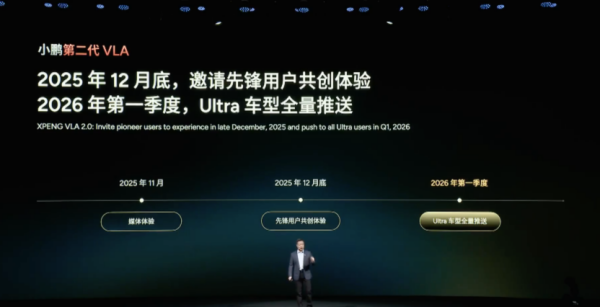
During the press conference, He Xiaopeng stated that the second-generation VLA large model represents a crucial step for XPENG in transitioning from intelligent driving to embodied intelligence. He revealed that a new iteration of their intelligent driving system, powered by this breakthrough technology, will commence a pioneer co-creation experience in late December and will be fully deployed on Ultra version models in the first quarter of 2026.
Technological Leap: Architectural Innovation in VLA Large Models
XPENG categorizes the second-generation VLA large model as a new paradigm for physical world modeling. It centers on vision, re-positioning language, which previously handled translation, as an auxiliary input, and directly outputs actions. This fundamentally breaks through the perception bottlenecks in intelligent driving.
He Xiaopeng elaborated that the second-generation VLA large model will serve as the “operating system for the physical AI world” in the future, acting as the foundational layer for all physical AI applications. This includes AI-powered cars, humanoid robots, and flying vehicles, providing a unified intelligent base. In essence, a single model will be applicable across cars, Robotaxis, robots, and flying cars.
XPENG’s second-generation VLA was trained on nearly 100 million video clips. This dataset is equivalent to the sum of extreme scenarios a human driver might encounter over 65,000 years of driving. This massive scale of training data endows the model with robust generalization capabilities. Supported by Alibaba Cloud’s massive computing cluster with 30,000 GPUs, and leveraging a 72 billion parameter base model, the system can achieve full-chain iteration every five days. This rapid iteration ensures continuous learning and evolution of the system.
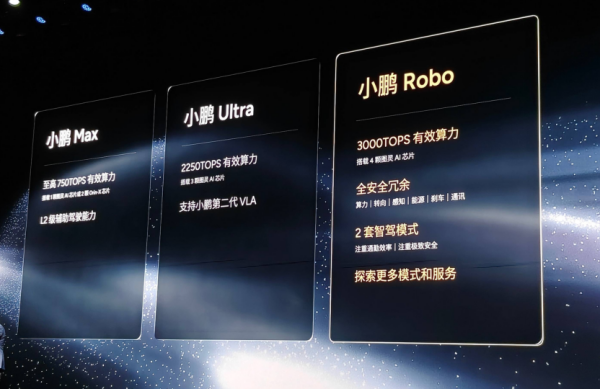
Through end-to-end optimization across chips, operators, and models, XPENG has equipped its Ultra version vehicles with its self-developed Turing AI chips, boasting a computing power of up to 2250 TOPS. These vehicles will house the second-generation VLA large model with a parameter scale in the billions, significantly exceeding the industry’s common tens of millions of parameters.
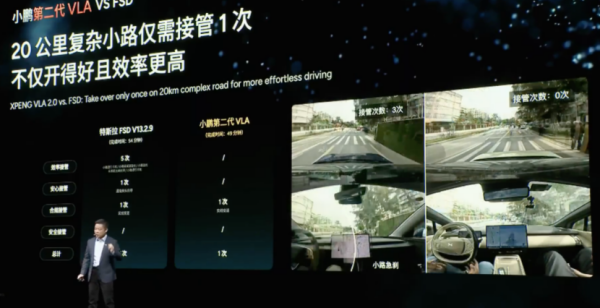
In terms of actual performance, the second-generation VLA large model will introduce XPENG’s “Xiao Lu NGP” (Navigation Guided Pilot). The average takeover distance in complex urban road scenarios is expected to increase by 13 times. It will also exhibit numerous new capabilities, such as recognizing hand gestures to stop and understanding traffic light logic. Furthermore, it will feature the debut of navigation-free autonomous driving, supporting SuperLCC+ human-machine co-driving, operable anywhere in the world.
Robots: Mass Production Scheduled for Late 2026
At the AI Tech Day, XPENG officially launched its new generation IRON humanoid robot. This robot utilizes the second-generation VLA large model and is equipped with three Turing AI chips, forming a high-level “brain” system combining VLT (Vision-Language-Transformer), VLA, and VLM (Vision-Language-Model) capabilities, with a total computing power also reaching 2250 TOPS.
XPENG highlighted seven core technical strengths of the IRON humanoid robot:
- Biomimetic Design: IRON features a human-like spine, biomimetic muscles, and a fully enclosed flexible skin, enabling human-like movements such as bending over to touch the ground.
- Dexterous Hands: The hands possess 22 degrees of freedom, offering enhanced manipulation capabilities.
- Display Interaction: The head integrates a 3D curved display, incorporating functions for hearing, speaking, seeing, and expressing emotions.
- Power System: It is equipped with the industry’s first application of all-solid-state batteries, achieving extreme lightweighting and super-high energy density.
- Safety Protection: The robot incorporates active safety protection measures to maximize the safety of participants in the physical AI world.
- Privacy Protection: An extended fourth law ensures that privacy data remains within the robot.
- Application Ecosystem: An open SDK allows for collaborative development of applications for humanoid robots with global developers.
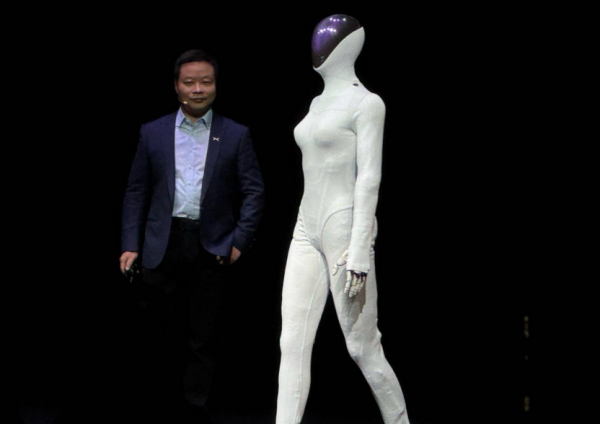
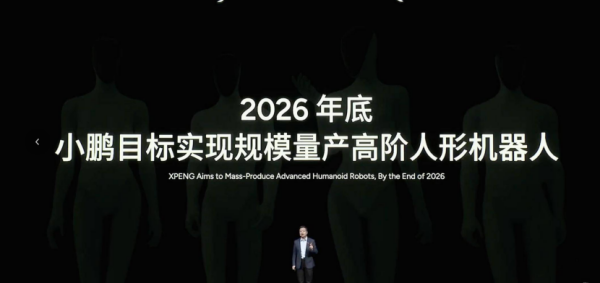
XPENG Motors has established its first embodied intelligence data factory in Guangzhou, laying the groundwork for the mass production of advanced humanoid robots by the end of 2026.
Revolutionizing Mobility: Robotaxis and Flying Cars Approaching Mass Production
At the AI Tech Day, XPENG Motors officially announced its plan to launch three Robotaxi models in 2026 and commence pilot operations.
These models will be equipped with four Turing AI chips, offering in-vehicle computing power of up to 3000 TOPS. Adopting a pure vision solution that does not rely on LiDAR or high-definition maps, they will feature two driving modes: one prioritizing commuting efficiency and the other emphasizing extreme safety. Additionally, XPENG Robotaxis will include external interaction features, displaying the vehicle’s intentions on the front windshield.
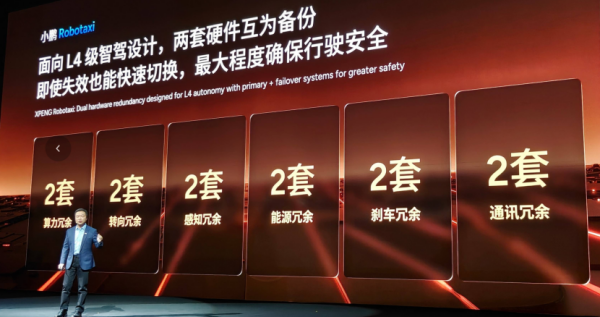
XPENG’s Robotaxis are designed with dual-redundant hardware architecture, allowing the two systems to serve as backups. This ensures rapid switching even if one system fails, maximizing driving safety. Empowered by VLM large models, XPENG’s Robotaxis will also feature a new interactive system, both inside and outside the vehicle, such as a sun visor display for external communication, giving the vehicles the ability to “communicate.”
AutoNavi (Gaode Maps) will be XPENG’s first global ecosystem partner for Robotaxis, and together they will provide Robotaxi services worldwide. Furthermore, XPENG will open its Robotaxi SDK to foster a global Robotaxi ecosystem with partners.
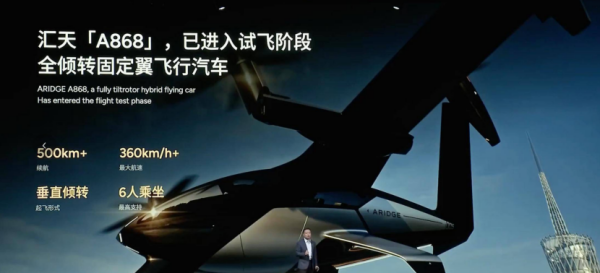
Concurrently, XPENG AeroHT unveiled the XPENG A868, a new generation all-rotating fixed-wing flying car. This flying car utilizes a hybrid system, boasting a claimed range of over 500 km and a maximum speed of 360 km/h. It can accommodate up to six passengers and features vertical take-off and landing, eliminating the need for runways.
XPENG AeroHT plans to develop two major flight systems: the “Land Aircraft Carrier,” designed for personal low-altitude flight experiences, and the A868, for efficient, long-range, multi-person travel. XPENG stated that the “Land Aircraft Carrier” is on the cusp of mass production, will be priced below 2 million RMB, and is scheduled for large-scale delivery in 2026, with global orders expected to exceed 7,000 units.
Strategic Partnership: Volkswagen’s Debut Collaboration
In terms of business collaborations, He Xiaopeng announced that Volkswagen has become the first strategic partner for XPENG’s second-generation VLA. Additionally, XPENG’s Turing AI chip has secured a designated supplier contract with Volkswagen. This signifies international top-tier automotive manufacturers’ recognition of XPENG’s technological prowess.
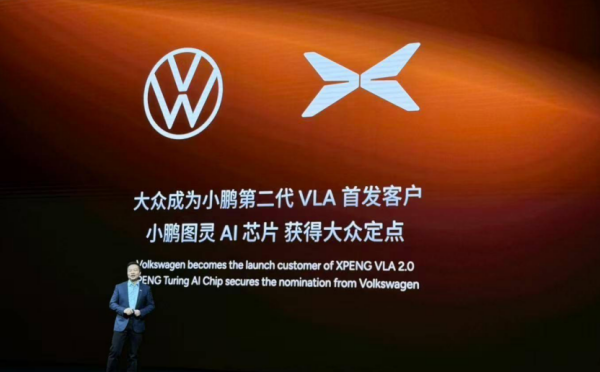
XPENG also announced that the second-generation VLA will be open-sourced to global commercial partners. This open strategy is expected to accelerate XPENG’s ecosystem building and enhance its technological influence within the industry.
He Xiaopeng emphasized that XPENG invests approximately 4.5 billion RMB annually in AI research and development, providing solid technical support for achieving L3 autonomous driving. This sustained high-intensity investment allows XPENG to maintain its leading edge in the intelligent driving sector.
With the launch of its second-generation VLA large model, XPENG Motors has taken a significant stride in the intelligent mobility landscape. He Xiaopeng believes that based on massive computing power, big data, and large models, AI will evolve and disrupt itself at an unimaginable pace. XPENG is poised to transition from a pure electric vehicle manufacturer to a builder of the physical AI world, signaling the emergence of a Chinese “Tesla.”


