Some automakers’ press conferences are all about leading the charge, while others seem to be perpetually drifting and leaving smoke trails.
Last Saturday evening, BMW China unveiled a highly anticipated new model at its annual event: the M3 Touring Competition, officially announcing the price of the M3 Touring Thunder Edition.
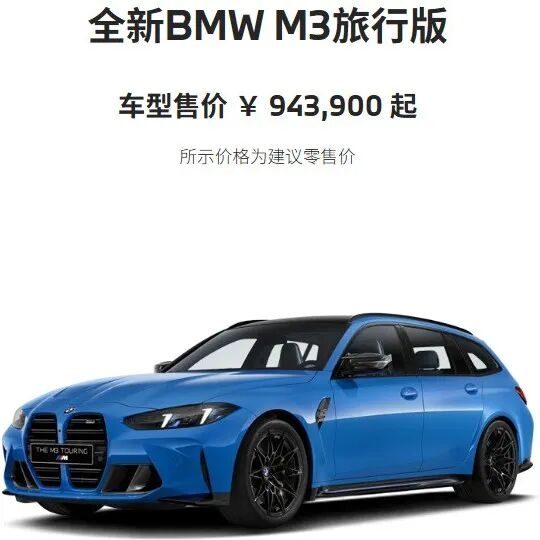
With a starting price of 943,900 yuan, many consider it a good deal, especially since it’s less than 80,000 yuan more expensive than the M3 sedan version.
This is a significant saving compared to the previous parallel import versions, which often exceeded 1.5 million yuan. In Europe, this price would barely fetch a 340i sedan in its standard trim.
However, there are also those who find the price point to be outrageously high.
For comparison, the Audi RS4, another six-cylinder performance wagon, retails for 828,800 yuan even without discounts. The Ford Mustang Mach-E, a powerful V8 sports car launched last year, is priced at an even more attractive 725,000 yuan.
But in my opinion, debating these comparisons is somewhat superfluous.

Unofficial sources suggest that BMW’s allocation for the M3 Touring in China will be limited to only 200-300 units annually. With such scarcity, coupled with an options list that rivals that of a Porsche 718, demand from BMW enthusiasts and wagon lovers is expected to be overwhelming.
The reality seems to confirm this anticipation.
At the launch event, a BMW salesperson reported receiving five pre-orders for the M3 Touring on the very same day. The entire year’s allocation could be spoken for in a matter of moments.

Even if its performance in the domestic market were to falter, it’s likely that many dealers would seek opportunities for parallel export.
Therefore, let’s set aside superficial market and sales discussions for now and delve into the insights we can glean from the M3 Touring itself and its launch event.
As I mentioned at the beginning, if you’re accustomed to new energy vehicle press conferences that are packed with feature lists and performance claims, the M3 Touring’s launch might not even feel like a formal unveiling.
The event barely touched upon technical specifications or direct comparisons with competitors. The most prominent segment was dedicated to drifting demonstrations.
Nearly every model under BMW’s M performance division was showcased performing drifts on the track, with the M2 leading, followed by the M3, then the M4.


The M4 drifted, followed by the M5…
However, the M5 made a more traditional entrance, showcasing that the “Bavarian scale weight’s” reputation for performance is still very much intact.

Our main feature, the M3 Touring, made its grand entrance last. After a brief drifting session with its brethren, a senior German executive from BMW announced, “The M3 Touring you’ve all been waiting for is finally here!”
And then, the event concluded.
Yes, it ended. Even the official pricing for the crucial M3 Touring was quietly released on the BMW app and website after the event.


Some might find it hard to believe that a few drifts would convince people to spend nearly a million yuan on a car. This approach could be seen as somewhat flippant.
However, if we were to use an RPG analogy, I’d say mainstream press conferences are like intricate JRPGs. You play through them and gradually understand the story, comparing it to others. They lay out their narratives clearly.
In contrast, BMW’s new car launch events are more akin to FromSoftware’s “Souls” series games. The narrative is cryptic, requiring players to decipher sparse clues, and interpretations can vary significantly among individuals.
The “clue” left by the M3 Touring at its launch was its drifting prowess.
Compared to the sedan version, the M3 Touring’s larger rear end adds 75 kilograms, theoretically raising its center of gravity and making it more challenging to control at its limits.
However, the M3 Touring’s drifting posture is virtually indistinguishable from the sedan or even the coupe models, maintaining a balletic smoothness.
Further investigation on the Nürburgring’s official website reveals that the M3 CS Touring lapped the circuit only 0.73 seconds slower than its sedan counterpart, with nearly identical performance.


This means it holds the record for the fastest production wagon around the Nürburgring.
Despite being heavier, it hasn’t sacrificed speed. The M3 Touring achieves this seemingly counter-intuitive feat through a combination of specialized chassis and body reinforcement components, as stated by BMW. These include mid-section and rear chassis reinforcements, crossbeams, cargo area bracing, and a specially designed rear subframe, all contributing to an enhanced dynamic capability.

Furthermore, the M3 Touring benefits from an exceptional underlying hardware foundation. It essentially embodies almost every pinnacle of internal combustion engine technology available today.
At its heart is the legendary S58 twin-turbo inline-six engine, boasting an impressive 530 horsepower and 650 Nm of torque. It incorporates numerous specialized features to enhance performance, rigidity, and heat dissipation.

These include a maximum fuel injection pressure of 350 bar, forged internal components for the pistons, crankshaft, and connecting rods, arc-sprayed titanium coating on the cylinder walls, a 3D-printed cylinder head core, a magnesium oil pan, and a sleeveless closed-deck crankcase.
Even the camshafts, responsible for valve control, are dual-camshafts for the Vanos variable valve timing function.
While these technical terms might seem complex, the key takeaway is that this exceptionally powerful six-cylinder engine can sustain full-throttle performance on the Nürburgring for over seven minutes, still capable of propelling the M3 Touring to speeds nearing 290 km/h on the main straight.

Beyond the engine, the M3 Touring’s M xDrive all-wheel-drive system is equally formidable.
Its rear-biased design profoundly benefits handling. The active multi-plate clutch limited-slip differential in the rear axle intelligently distributes power between the rear wheels based on various inputs, such as throttle position, wheel speed, and yaw rate, to enhance cornering agility.

Remarkably, when the DSC (Dynamic Stability Control) system is completely deactivated, the M3 Touring’s transfer case can disconnect the front axle entirely. This allows all power from the S58 engine to be channeled to the rear wheels, transforming the M3 Touring into a powerful rear-wheel-drive machine, enabling the fluid and controlled drifts we saw earlier.
Layered atop this impressive core hardware, perhaps the most captivating aspect of the M3 Touring is its undeniably stylish exterior.

After years of its introduction, most enthusiasts have come to accept and even appreciate the G-chassis M3/M4’s distinctive “large grille” design. Some even find it looks better with time.
While many lamented the M3 sedan’s shorter rear end compared to the M4’s more flowing profile, the M3 Touring elegantly addresses this drawback.
The visually lower rear stance imparts a sense of maturity reminiscent of a two-door GT. Viewed from the rear, the pronounced wide body over the rear fenders and sharp creases create a striking contrast. Amidst the current wave of rounded, “green” (presumably referring to eco-friendly vehicle initiatives) wagons, the M3 Touring stands out with a sexiness that rivals Brad Pitt among a boy band.

Amusingly, the M3 Touring’s extended rear does offer a touch of practicality.
The taller trunk can accommodate more luggage, and the larger tailgate can be opened partially, similar to the X5’s split tailgate, making it incredibly convenient for loading smaller items.
Source: @Zhong Ji Xiao Teng

Adding to its appeal, the M3 Touring now comes standard with BMW M’s iconic “helipad” seats in China. For me and many other internal combustion engine enthusiasts, it represents the near-perfect embodiment of a four-door performance car.

The only true disappointment is that, like many overseas automakers, BMW in the Chinese market is experiencing a significant “generational gap” or lack of succession.
In the past, fans of these brands, even if they couldn’t afford the top-tier performance models, could still find a similar driving experience in their less performance-oriented counterparts which shared the same underlying architecture and technology. For example, while the F80 M3 was expensive, a regular F30 3 Series still offered an engaging drive. Similarly, one might not afford an eight-cylinder W204 C63, but a standard C-Class still provided a sporty feel.


However, today, after being excited by the M3 Touring and deciding to wholeheartedly become a “Bimmer” enthusiast, you might find that when you look for a BMW in the 200,000-300,000 yuan range, regardless of whether it’s a gasoline or electric model, the prevailing theme is cost-cutting, feature reductions, and price adjustments made to appease the mass market.
The shared DNA with high-performance models is becoming increasingly diluted, if not entirely absent. Top-tier technology seems to be exclusively reserved for the most expensive vehicles.
This trend is evident not only with BMW but also with Ford, Toyota, Nissan, and Audi.
One could argue that this is a necessary compromise for traditional automakers to survive in the electric vehicle era. However, it could also signify the twilight of the glorious era of internal combustion engines – a time when both ordinary owners and high-end enthusiasts could passionately discuss their brand’s capabilities. That era may indeed be drawing to a close.

Reflecting on the M3 Touring with this thought in mind, I’m overcome by a profound sense of loss.
Because despite being the most powerful and most affordable wagon in BMW M history,
It seems to be drifting further and further away from me (though it was never truly close to begin with).